
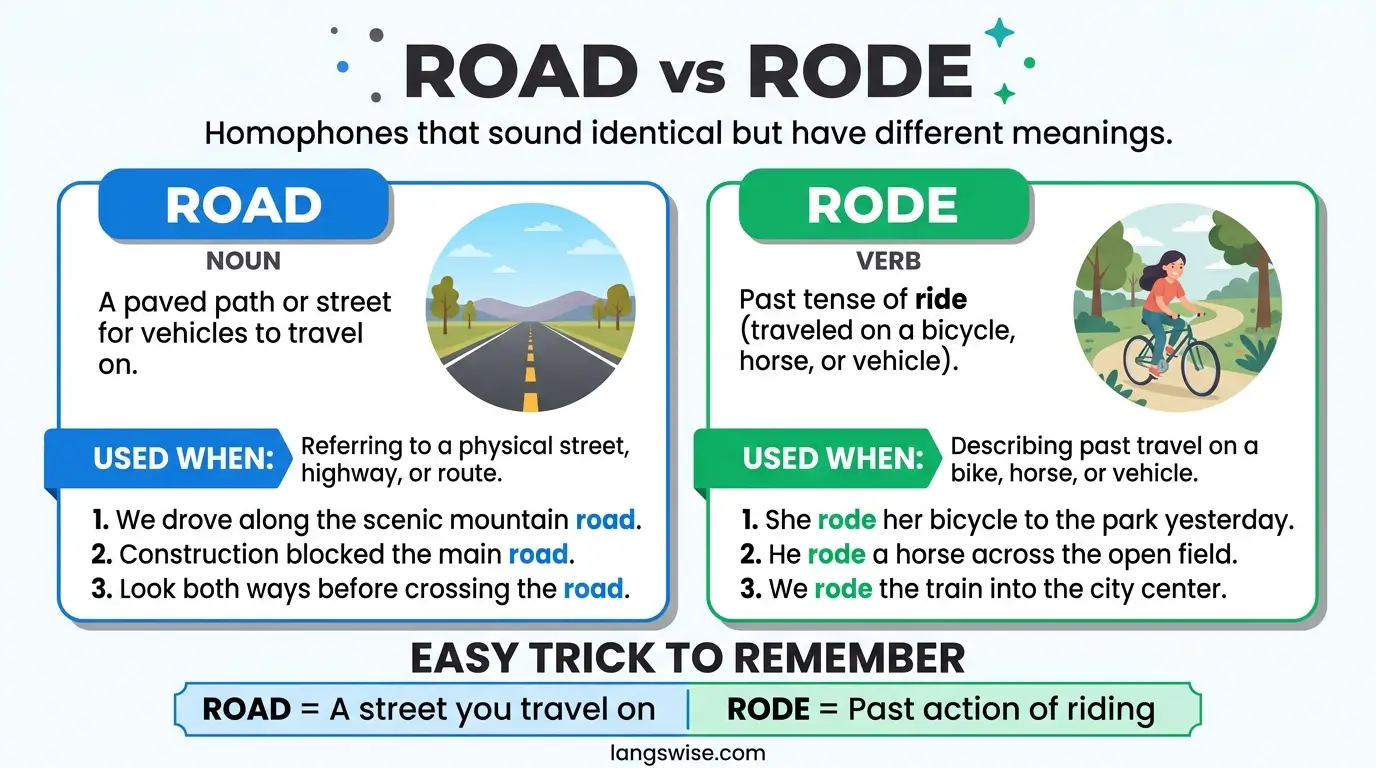
Road or Rode: What Is the Difference? Meaning, Spelling, and Examples
Have you ever stopped while writing because you were unsure whether to use road or rode? You are not alone.
Many English learners, students, and even native speakers mix up these two words because they sound exactly the same. However, their meanings and uses are very different.
The word road is a noun. It means a path or way used by cars, bikes, and people.
The word rode is a verb. It is the past tense of ride. For example, you can drive on a road, but you rode a bike yesterday.
People often search for road or rode because both words have the same pronunciation.
This makes spelling difficult, especially when writing emails, schoolwork, social media posts, or professional content.
In this guide, you will learn the difference between road and rode, their origins, spelling rules, common mistakes, and everyday examples.
By the end, you will know exactly which word to use.
Road or Rode Quick Answer
Road is a noun that means a path or route. Rode is the past tense of the verb ride. Both words sound the same, but their meanings are different.
Here are two simple examples:
- Road: We walked along the quiet road.
- Rode: She rode her bicycle to school.
Remember this easy rule:
- Use road when talking about a street, path, or route.
- Use rode when talking about someone who traveled on a bike, horse, or other ride in the past.
Both spellings are correct in American and British English. The difference is not regional. It depends on the meaning of your sentence.
The Origin of Road or Rode
The words road and rode come from different language histories.
Where Does Road Come From?
The word road comes from the Old English word rād. It was linked to riding, traveling, and journeys. Over time, its meaning developed into a path or route used for travel.
Today, a road can be a small village lane, a city street, or a major highway.
Example: The new road connects two small towns.
Where Does Rode Come From?
The word rode comes from the Old English verb rīdan, which means to ride or travel on something.
It developed as the past tense form of ride. English uses rode to describe an action that happened in the past.
Example: He rode a horse during his holiday.
Why Are Road and Rode Spelled Differently?
English has many words that sound alike but have different meanings and spellings. These words are called homophones.
Road and rode are homophones because they share the same pronunciation but have different meanings and grammatical roles.
Their spelling reflects their separate word histories, not a difference between British and American English.
British English vs American English Spelling
There is no spelling difference between road and rode in British and American English.
Both countries use the same spelling for these two words. The meaning also stays the same.
| Word | American English | British English | Meaning |
|---|---|---|---|
| Road | Road | Road | A path or route |
| Rode | Rode | Rode | Past tense of ride |
| Ride | Ride | Ride | To travel on something |
| Roads | Roads | Roads | More than one road |
Examples in American English
- I drove down the road.
- He rode his bike to work.
- The road is closed today.
Examples in British English
- We walked along the road.
- She rode her horse in the park.
- The road leads to the village.
As you can see, both varieties use the same spelling. You do not need to change road or rode when writing for readers in the United States or the United Kingdom.
Which Spelling Should You Use?
Your choice depends on what you want to say, not where your readers live.
For US Readers
Use road for a street or route. Use rode for a past riding action.
Example: I rode my bike along the road.
For UK and Commonwealth Readers
The same rule applies in British English and other varieties of English.
Example: They rode their horses down the country road.
For Global Readers
If you write for an international audience, use the correct word based on its meaning. Both spellings are understood around the world.
A simple tip is to replace rode with drove or traveled on. If the sentence still makes sense, rode may be correct. If you mean a street or path, choose road.
Common Mistakes with Road or Rode
Many people make spelling mistakes because road and rode sound alike. Here are some common errors and their corrections.
| Incorrect Sentence | Correct Sentence | Why? |
|---|---|---|
| I rode to school on a long road. | I rode to school on a long road. | Both words are correct here. |
| We walked along the rode. | We walked along the road. | A path is a road. |
| She road her bike yesterday. | She rode her bike yesterday. | Rode is the past tense of ride. |
| The horse road fast. | The horse rode fast. | Rode describes a past action. |
| This rode is very busy. | This road is very busy. | A street is a road. |
Mistake 1: Using Road Instead of Rode
Incorrect: He road his bicycle yesterday.
Correct: He rode his bicycle yesterday.
Use rode because the sentence describes an action in the past.
Mistake 2: Using Rode Instead of Road
Incorrect: We live near a quiet rode.
Correct: We live near a quiet road.
Use road because the sentence talks about a place.
Mistake 3: Thinking They Have Different Regional Spellings
Some writers think road is American English and rode is British English. This is not true. Both words are used in both varieties.
Road or Rode in Everyday Examples
The best way to learn these words is to see how people use them in daily writing.
1. In Emails
- The office is located on Green Road.
- I rode my bike to work this morning.
2. In News
- Police closed the main road after an accident.
- A young cyclist rode across the city to raise money for charity.
3. On Social Media
- Beautiful views along the country road!
- I rode my bike for ten miles today.
4. In Formal Writing
- The new road will improve transport between the two cities.
- The athlete rode his bicycle during the final stage of the race.
5. In Everyday Conversation
- Is this the right road to the airport?
- I rode a horse for the first time yesterday.
These examples show that road names a place or route, while rode describes a completed action.
Road or Rode Google Trends & Usage Data
People search for road or rode because the words sound the same. They want to know which spelling is correct and how to use each word.
Both words are common in everyday English, but they appear in different contexts.
How Is Road Used?
The word road appears often in topics related to:
- Travel and transport
- Driving and traffic
- Maps and directions
- City planning
- Streets and highways
For example, people may search for road safety, road conditions, or the nearest road.
How Is Rode Used?
The word rode is often found in topics related to:
- Riding bicycles
- Horse riding
- Motorbike trips
- Past travel experiences
- Personal stories
For example, people may write, “I rode my bike yesterday.”
Which Word Is More Popular?
The word road has a much wider range of everyday uses because it names a common place and appears in many topics. The word rode is more limited because it is mainly used as the past tense of ride.
However, search popularity can change by country, time, and topic. Google Trends compares search interest over time and by location. Its scores are relative, not exact search volumes.
You can compare both terms directly using Google Trends:
Important: Do not treat a Google Trends score as the total number of searches. It shows relative interest, not exact monthly search volume.
Road and Rode – Comparison Table
Here is a quick side-by-side comparison to help you remember the difference.
| Feature | Road | Rode |
|---|---|---|
| Part of speech | Noun | Verb |
| Meaning | A street or path | Past tense of ride |
| Pronunciation | /roʊd/ | /roʊd/ |
| Word form | Singular noun | Simple past verb |
| Present form | Not applicable | Ride |
| Example | The road is wide. | I rode a bike. |
| Common context | Travel and transport | Riding and movement |
Easy memory trick: Road has an a like path. Rode has an o like rode a horse. This simple trick can help you remember which word to choose.
Frequently Asked Questions About Road or Rode
1. Is it road or rode?
Both words are correct, but they have different meanings. Road means a street or path, while rode is the past tense of ride. Choose the word that matches your sentence.
2. What is the difference between road and rode?
Road is a noun used for a street, path, or route. Rode is a verb used for an action that happened in the past. For example, “I rode my bike on the road.”
3. Are road and rode pronounced the same?
Yes, road and rode are pronounced the same in standard English. They are homophones because they sound alike but have different meanings and spellings. Their pronunciation is usually /roʊd/.
4. Is rode the past tense of ride?
Yes, rode is the simple past tense of the verb ride. For example, “I ride a bike” describes the present, while “I rode a bike yesterday” describes the past. The past participle is ridden.
5. Is road American or British English?
Road is used in both American and British English. It has the same spelling and meaning in both varieties. You can use it when writing for readers in either country.
6. Can I use rode for a street?
No, rode cannot be used to mean a street or path. The correct word is road when you are talking about a route. For example, “This road leads to the city.”
7. How can I remember road and rode?
Remember that road means a path, while rode means someone traveled on something in the past. Try replacing rode with “traveled on” to check your sentence. This simple trick can help prevent spelling mistakes.
Final Thoughts
The difference between road and rode is simple once you understand their meanings. Road is a noun for a street or path, while rode is the past tense of ride.
Both words are correct in American and British English. They are not spelling variations of the same word. Use road when discussing a route and rode when describing a past riding action.
Keep practicing with simple sentences, and you will soon know which spelling to use without confusion.