Sight or Site? Meaning, Examples, and Usage
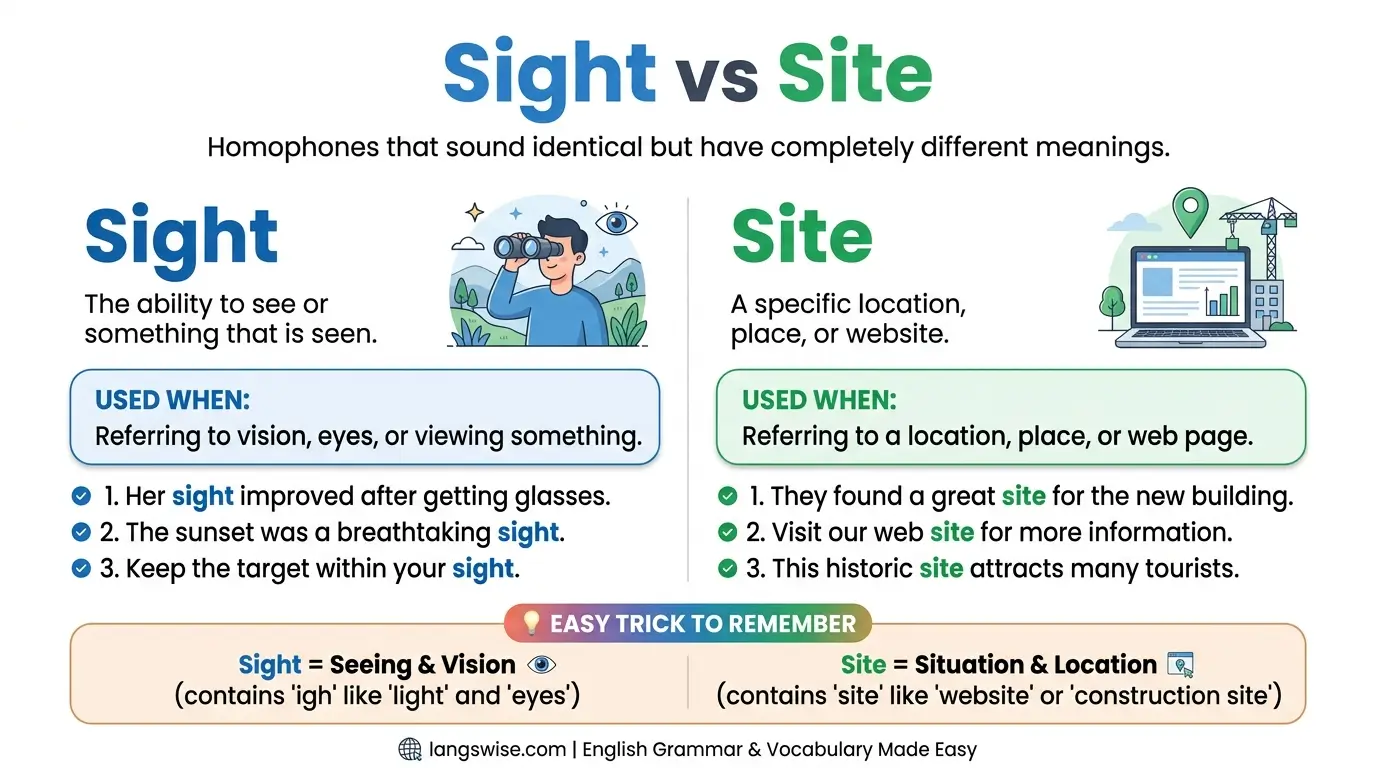
Sight means something you see or your ability to see, while site means a place or location. Both sound the same but have different meanings.
Have you ever wondered whether to write sight or site? These two words sound exactly the same, but they have very different meanings.
This makes them easy to mix up in emails, schoolwork, social media posts, and professional writing.
Choosing the wrong word can change the meaning of your sentence.
The word sight relates to seeing, vision, or something you can look at.
For example, you might enjoy the sight of a beautiful sunset or visit a famous sight while traveling.
On the other hand, site refers to a place, location, or area where something happens or is built.
For example, a construction site is a place where workers build something.
People often search for these words because they share the same pronunciation but have different spellings and meanings.
In this guide, you will learn their definitions, origins, spelling differences, and everyday uses.
You will also discover simple examples and tips to help you choose the correct word every time.
Sight or Site Quick Answer
Both sight and site are correct English words, but they have different meanings.
Sight relates to seeing, while site means a place or location.
- Sight: The ability to see or something you can see.
- Site: A place where something is located, built, or happening.
Examples:
- The mountain was a beautiful sight.
- Workers arrived at the building site.
Remember: Sight is about seeing, while site is about a place.
The Origin of Sight or Site
The words sight and site have different histories. Both came into English through older language forms, but their meanings developed in different ways.
Sight comes from Old English sihth, which relates to seeing and vision.
Over time, it developed into the modern word used for eyesight, views, and things people can see.
Site comes from Latin situs, meaning position or location.
It entered English through French and became a word for a particular place or area.
Their different origins explain why they have different spellings and meanings, even though they sound alike today.
British English vs American English Spelling
There is no spelling difference between British and American English for sight and site.
Both countries use the same spelling and meanings.
These words are not regional spelling variations.
Their correct use depends on the meaning of the sentence, not the country where you are writing.
| Word | British English | American English | Meaning |
|---|---|---|---|
| Sight | Sight | Sight | Seeing or something visible |
| Site | Site | Site | A place or location |
Examples:
- British English: The castle was a wonderful sight.
- American English: The castle was a wonderful sight.
- British English: They visited the building site.
- American English: They visited the building site.
Both spellings are correct in the UK, US, Canada, Australia, and other English-speaking countries.
Which Spelling Should You Use?
Your choice depends on what you want to say. Think about the meaning before choosing either word.
For US audiences: Use sight when talking about vision or something visible. Use site when describing a location or place.
For UK and Commonwealth audiences: Follow the same rule.
Both words have identical spellings in British, Australian, Canadian, and other Commonwealth English.
For global audiences: Use the standard spellings of sight and site.
They are understood worldwide and do not change between English varieties.
The easiest rule is to remember that sight is connected to seeing, while site is connected to location.
Common Mistakes with Sight or Site
Many writers confuse these words because they sound the same.
However, their meanings are different, so using the wrong spelling can create confusion.
Here are some common mistakes and their corrections:
| Incorrect Sentence | Correct Sentence |
|---|---|
| The construction sight is busy. | The construction site is busy. |
| It was a beautiful site to see. | It was a beautiful sight to see. |
| I visited the historical sight. | I visited the historical site. |
| The website is a beautiful sight. | The website is a useful site. |
Common errors to avoid:
- Using sight when talking about a building location.
- Using site when describing something beautiful to see.
- Assuming one spelling belongs to British English and the other to American English.
Always check the meaning of your sentence before choosing a word.
Sight or Site in Everyday Examples
Both words appear in everyday communication.
You can find them in emails, news reports, social media posts, and formal documents.
Understanding their uses will help you write clear and correct sentences.
1. In Emails
- Sight: The view from our office is a beautiful sight.
- Site: Please visit the project site tomorrow.
2. In News
- Sight: The rare bird was a wonderful sight for visitors.
- Site: Officials inspected the accident site.
3. On Social Media
- Sight: What an amazing sight at sunset!
- Site: Check out our new website and visit the official site.
4. In Formal Writing
- Sight: The report describes the sight of the historic monument.
- Site: The company selected a new site for its factory.
These examples show that sight describes seeing, while site identifies a location.
Sight or Site Google Trends & Usage Data
The words sight and site are both common in English searches.
However, people use them in different contexts because their meanings are not the same.
Sight often appears in searches related to eyesight, beautiful views, tourist attractions, and visual experiences.
People also use it in phrases such as “out of sight” and “a sight to behold.”
Site is common in searches about websites, construction projects, business locations, and historical places.
Phrases such as “website,” “job site,” and “construction site” are widely used.
Their popularity can vary by country and search context.
However, there is no reliable basis here for claiming that one word is more popular in a particular country.
Sight vs Site Comparison Table
The following table makes the difference between these words easy to understand.
| Feature | Sight | Site |
|---|---|---|
| Meaning | Seeing or vision | Place or location |
| Part of speech | Noun | Noun |
| Pronunciation | /saɪt/ | /saɪt/ |
| Related word | Sightseeing | Website |
| Common phrase | A beautiful sight | Construction site |
| Example | The view was a sight. | This is the project site. |
| Memory tip | Think of seeing | Think of a place |
Both words are pronounced the same way, but their meanings and uses are different.
FAQs About Sight or Site
1. What is the difference between sight and site?
Sight means the ability to see or something that you can look at. Site means a particular place or location.
For example, a beautiful sunset is a sight. A building location is a site.
2. Is it sight or site to see?
The correct phrase is sight to see. It describes something interesting, beautiful, or surprising to look at.
Example: The waterfall was an amazing sight to see.
3. Is a website called a sight or site?
The correct word is site. A website is a collection of related web pages available online.
Example: I found useful information on this website.
4. Is it construction sight or construction site?
The correct phrase is construction site. It means a place where workers build or repair something.
Example: The workers arrived at the construction site early.
5. Do sight and site sound the same?
Yes, sight and site are homophones. This means they have the same pronunciation but different meanings and spellings.
Both words are pronounced /saɪt/.
6. Is sight or site used in British English?
Both words are used in British English. Sight refers to seeing, while site refers to a location.
Their spellings and meanings are the same in American English.
7. How can I remember sight vs site?
Remember that sight has the word connection to seeing and vision. Site refers to a place or location.
A simple trick is: You see a sight, but you visit a site.
Conclusion
Understanding the difference between sight and site is simple once you know what each word means. Both words are correct, but they cannot be used in place of each other.
Sight relates to seeing, vision, or something visible, while site refers to a particular place or location.
For example, you can enjoy the sight of a beautiful beach, but you can also visit a construction site. These examples show how one letter can change the meaning of a sentence.
Both words have the same pronunciation, which is why writers sometimes confuse them in everyday communication.
Remember that sight and site have the same spelling in British and American English. There is no need to choose based on your audience’s location. Instead, focus on the meaning you want to express.
The easiest way to remember the difference is this: You see a sight, but you visit a site.
Keep this simple rule in mind, and you can use both words correctly in emails, articles, schoolwork, and professional writing.