Seam or Seem: What Is the Difference and Which Spelling Is Correct?
Seam means a joined line in fabric, while seem means to appear.
Have you ever wondered whether to write seam or seem? These two words sound exactly the same, but they have very different meanings.
This can make them confusing, especially when writing emails, school assignments, social media posts, or professional documents.
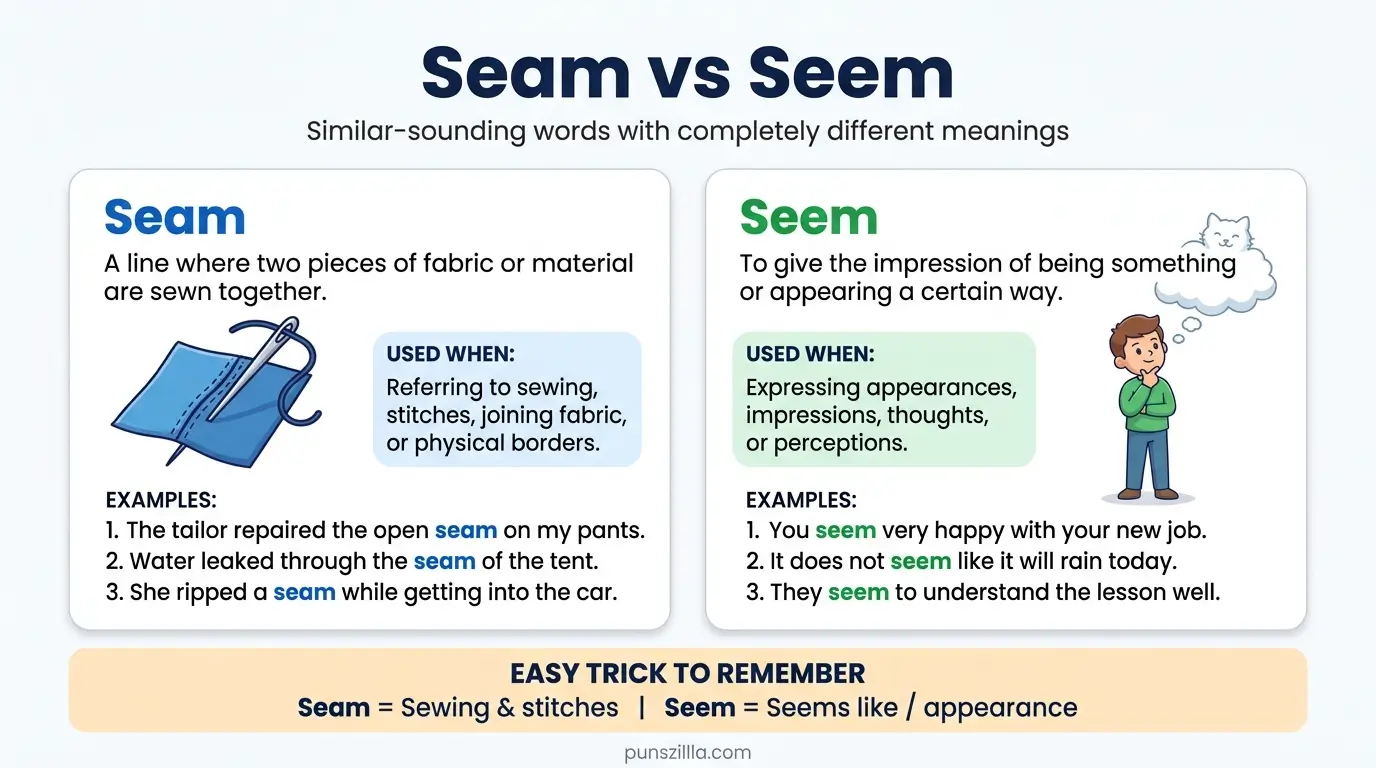
The good news is that both spellings are correct English words. However, you cannot use them in the same way. Seam refers to a line where two pieces of fabric or material are joined. Seem means to appear or give a certain impression.
People often search for “seam or seem” because these words are homophones. They have the same pronunciation but different meanings and spellings. Choosing the wrong word can change the meaning of a sentence and make your writing unclear.
In this guide, you will learn the difference between seam and seem, their origins, spelling rules, common mistakes, and everyday examples. You will also discover which spelling to use in American, British, and international English.
Seam or Seem – Quick Answer
Seam means a line where two pieces of fabric or material are joined. Seem means to appear or look a certain way.
Both words are correct, but they have different meanings.
- Seam: The seam on my shirt is coming apart.
- Seem: You seem happy today.
Easy way to remember:
- Seam = Sewing and stitching.
- Seem = Something appears to be true.
The Origin of Seam or Seem
The words seam and seem have different histories, even though they sound alike today.
Origin of Seam
The word seam comes from the Old English word seam, which referred to a joining line or a place where things were sewn together.
It is related to the idea of joining pieces of cloth, leather, or other materials. Over time, its meaning became closely connected to sewing, clothing, and construction.
Today, seam usually describes a line where two pieces of material are joined.
Example: The tailor repaired the seam on my jacket.
Origin of Seem
The word seem comes from the Old Norse word sœma, which meant to be fitting or suitable. It entered English through historical language contact and developed into its modern meaning.
Today, seem is used when something appears to be a certain way or gives a particular impression.
Example: She seems excited about her new job.
Why Are Their Spellings Different?
Seam and seem have different spellings because they developed from different historical word roots.
English spelling preserves many older word forms, even when pronunciation changes over time. That is why two words can sound the same but have different meanings and spellings.
British English vs American English Spelling
There is no spelling difference between seam and seem in British and American English.
Both countries use the same spelling for each word. The difference is in their meanings, not their regional spelling rules.
| Word | American English | British English | Meaning |
|---|---|---|---|
| Seam | Seam | Seam | A joined line in material |
| Seem | Seem | Seem | To appear or look |
| Seams | Seams | Seams | More than one joining line |
| Seems | Seems | Seems | Appears or looks |
| Seamed | Seamed | Seamed | Joined or marked with seams |
| Seeming | Seeming | Seeming | Appearing to be something |
Examples in American English
- The seam of my jeans is torn.
- You seem tired today.
Examples in British English
- The seam on her dress needs repair.
- They seem ready for the meeting.
Key point: Whether you write in American or British English, always use seam for a joining line and seem for appearing or giving an impression.
Which Spelling Should You Use?
The correct spelling depends on what you want to say, not where your readers live.
For American English
Use seam when discussing sewing, clothing, or joined materials. Use seem when describing how something appears.
Example: The seam on this shirt looks weak.
Example: You seem very confident.
For British English and Commonwealth Countries
The same spelling rules apply in the UK, Pakistan, Australia, Canada, and other Commonwealth countries.
Example: The seam of the coat needs fixing.
Example: You seem happy with the results.
For Global English
If you write for an international audience, follow the same rule.
Remember that seam and seem are not regional spelling variations. They are two separate words with different meanings.
Common Mistakes with Seam or Seem
Writers often confuse these words because they have identical sounds. Here are some common mistakes and their corrections.
| Incorrect Sentence | Correct Sentence | Reason |
|---|---|---|
| The seem is coming apart. | The seam is coming apart. | Seam refers to a joining line. |
| You seam upset. | You seem upset. | Seem means to appear. |
| Check the seem of your trousers. | Check the seam of your trousers. | A seam is part of clothing. |
| It seams like a good idea. | It seems like a good idea. | Seem describes an impression. |
| The dress has a broken seem. | The dress has a broken seam. | Seam is used for stitching. |
How to Avoid These Mistakes
Use these simple tips:
- Think about sewing: If your sentence involves clothes, fabric, or stitching, use seam.
- Think about appearance: If something looks or feels a certain way, use seem.
- Check the meaning: Read your sentence again to make sure the word fits.
- Learn simple examples: Practice using both words in everyday sentences.
Seam or Seem in Everyday Examples
Both words appear in everyday communication. However, their uses depend on the context.
1. In Emails
Seam: Please check the seam on the new uniforms before delivery.
Seem: You seem to have missed the attachment in my last email.
2. In News Writing
Seam: The clothing factory repaired a seam in the damaged uniform.
Seem: The new policy seems likely to affect small businesses.
3. On Social Media
Seam: The seam on my handmade dress looks perfect!
Seem: You seem to be having a great day!
4. In Formal Writing
Seam: The designer examined every seam before approving the finished garment.
Seem: The findings seem to support the original research.
5. In Everyday Conversation
Seam: There is a small hole near the seam of my trousers.
Seem: You seem busy today.
Seam or Seem – Comparison Table
The following table shows the main differences between these two words.
| Feature | Seam | Seem |
|---|---|---|
| Part of speech | Noun or verb | Verb |
| Main meaning | A joined line | To appear |
| Pronunciation | /siːm/ | /siːm/ |
| Related word | Sewing | Appearance |
| Common use | Clothes and materials | Feelings and impressions |
| Example | The seam is loose. | You seem happy. |
| Plural form | Seams | Not applicable |
| Third-person form | Seams (verb) | Seems |
Quick Memory Trick
- Seam: Think of a sewing machine.
- Seem: Think of how something appears.
This simple trick can help you choose the correct word whenever you write.
Seam or Seem – Google Trends and Usage Data
Seam and seem are both established English words, but they appear in different search and writing contexts.
People usually search for these words when they want to check spelling, understand their meanings, or correct a sentence.
Which Word Is More Common?
In everyday English, seem is widely used because it is a common verb in conversations, emails, articles, and other forms of writing.
Seam is more closely connected to specific topics, such as:
- Clothing and fashion
- Sewing and tailoring
- Textile production
- Construction and manufacturing
- Product design
Search Interest by Country
Both words are relevant in countries where English is widely used, including:
| Country | Common Search Context |
|---|---|
| United States | Spelling, grammar, and everyday usage |
| United Kingdom | English vocabulary and writing |
| Canada | Grammar and word meanings |
| Australia | Spelling and vocabulary |
| Pakistan | English learning and confusing words |
| India | Grammar, spelling, and vocabulary |
What About Google Trends?
Google Trends can help compare search interest for seam and seem across different countries and time periods.
However, exact popularity rankings and search volumes require a live Google Trends comparison. No verified numerical figures are provided here.
You can compare both terms directly using Google Trends by selecting your target country, time range, and search category.
Important: Search interest does not always show how frequently a word appears in everyday writing. The meaning and context of each word are more useful when deciding which spelling to use.
Frequently Asked Questions (FAQs)
1. Is it seam or seem?
Both words are correct, but they have different meanings. Seam refers to a joining line in fabric, while seem means to appear or give an impression.
2. What is the difference between seam and seem?
Seam is used for stitching or joining materials. Seem is used when something appears to be a certain way.
3. Do seam and seem sound the same?
Yes, both words are pronounced /siːm/. They are homophones because they have the same pronunciation but different meanings and spellings.
4. How do you use seam in a sentence?
Use seam when talking about a joined line in clothing or material. Example: The seam on my jacket needs repair.
5. How do you use seem in a sentence?
Use seem when describing how something appears. Example: You seem happy with your new results.
6. Is seem a real English word?
Yes, seem is a common English verb. It describes how something appears or gives an impression.
7. Do British and American English use the same spelling?
Yes, both American and British English use seam and seem with the same spelling. There are no regional spelling differences between these words.
Conclusion
Understanding the difference between seam and seem is simple once you learn their meanings. Both words sound the same, but they are used in different situations. Seam refers to a line where two pieces of fabric or material are joined. Seem means to appear or give an impression.
Remember the connection between seam and sewing. If you are talking about clothes, stitching, or joined materials, seam is the correct choice. If you are describing how someone or something looks, feels, or appears, use seem.
There is no difference between British and American English spelling for these words. The same rules also apply to writers in Pakistan and other English-speaking countries.
For professional writing, always check the meaning of the sentence before choosing a spelling. A small spelling mistake can change your message or confuse your readers. Learning these simple differences will help you write more clearly and confidently.