
Lay or Laid: Which One Is Correct?
Choosing between lay or laid can be confusing, even for strong English speakers. Both words are correct, but they have different uses and verb forms.
The main problem is that lay can be both a present-tense verb and part of the past forms of another verb. This makes sentences like “I lay down” and “I laid the book down” easy to mix up.
People often search for “lay or laid” because they want to know which word is correct when talking about putting something somewhere or resting.
The key is to look at what comes after the verb. Lay usually needs an object, while lie does not. Laid is the past tense and past participle of lay.
In this guide, you will learn the simple difference between lay and laid, their origins, common mistakes, everyday examples, and usage differences. By the end, you will know exactly when to use each form in your writing and speech.
Lay or Laid Quick Answer
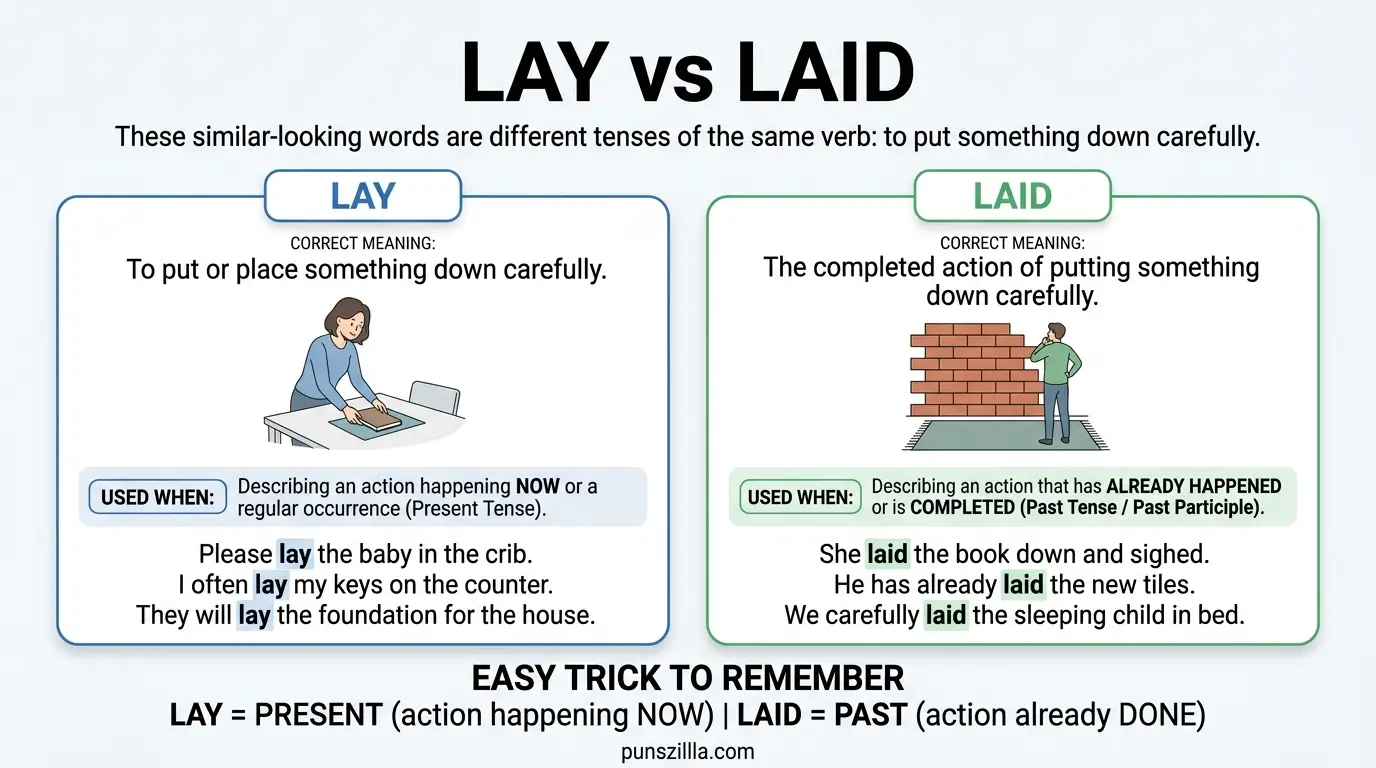
Lay is the present tense of the verb lay, while laid is its past tense and past participle.
- Lay: I lay the book on the desk every morning.
- Laid: I laid the book on the desk yesterday.
- Laid: She has laid the keys on the table.
The verb lay means to put or place something somewhere. It normally needs an object.
Simple Rule
Today / regularly → lay
Yesterday / already happened → laid
| Time | Correct word | Example |
|---|---|---|
| Present | lay | I lay the clothes on the bed. |
| Past | laid | I laid the clothes on the bed. |
| Past participle | laid | She has laid the clothes on the bed. |
Do not confuse lay with lie. Lie means to rest or be in a flat position.
- I lie on the bed every afternoon.
- Yesterday, I lay on the bed.
- I have lain on the bed for an hour.
The Origin of Lay or Laid
The word lay has a long history in English. It comes from Old English lecgan, meaning “to put” or “to place.” Over time, its spelling and pronunciation changed into the modern English word lay.
Laid developed as the past form of lay. Unlike many regular English verbs, its past form does not use the usual -ed pattern in the same way as words such as “walked” or “played.” Instead, lay becomes laid.
The word lay is also connected to the verb lie, but they are different verbs with different meanings.
- Lay → laid → laid
- Lie → lay → lain
This is one major reason English learners find these words difficult. The word lay is also the past tense of lie, which creates extra confusion.
For example:
- Present: I lie down.
- Past: I lay down.
- Present: I lay the baby down.
- Past: I laid the baby down.
British English vs American English Spelling
There is no major spelling difference between British and American English for lay and laid. Both varieties use the same spellings.
The main difference is not spelling. It is how speakers may use certain expressions and how formal or regional usage can vary.
| Word | British English | American English | Meaning |
|---|---|---|---|
| lay | lay | lay | Put or place something |
| laid | laid | laid | Past form of lay |
| lie | lie | lie | Rest or recline |
| lay | lay | lay | Past form of lie |
| lain | lain | lain | Past participle of lie |
Examples
British English:
She laid the documents on the desk.
American English:
She laid the documents on the desk.
Both are correct.
The important point is to focus on the meaning and verb tense, not on British versus American spelling.
Which Spelling Should You Use?
Choose lay or laid based on the tense of your sentence.
For a US Audience
Use lay for present actions and laid for past actions.
- I lay the papers here every day.
- I laid the papers here yesterday.
For a UK or Commonwealth Audience
The same basic rule applies.
- He lays the table every evening.
- He laid the table yesterday.
For a Global Audience
Use standard English grammar. The words lay and laid are understood in both British and American English.
If you are writing for work, school, or a website, check whether your audience follows British or American English. However, the choice between lay and laid is mainly a grammar issue, not a regional spelling issue.
Common Mistakes with Lay or Laid
Mistake 1: Using “lay” for a completed action
Incorrect:
Yesterday, I lay the book on the table.
Correct:
Yesterday, I laid the book on the table.
Mistake 2: Using “laid” for the present
Incorrect:
I laid the book here every day.
Correct:
I lay the book here every day.
Mistake 3: Confusing “lay” with “lie”
Incorrect:
I am going to lay down.
Correct:
I am going to lie down.
Here, there is no object. You are resting yourself.
Mistake 4: Using “laid” after “has” incorrectly
Correct:
She has laid the baby in the crib.
Incorrect:
She has lay the baby in the crib.
After has, use the past participle laid.
Mistake 5: Forgetting that “lay” can be the past of “lie”
Correct:
Yesterday, I lay on the sofa.
Here, lay does not mean “put.” It is the past tense of lie.
Lay or Laid in Everyday Examples
Understanding real-life examples makes the difference much easier.
In Emails
I laid the documents on your desk this morning.
Please lay the forms on the front table.
In News Writing
Workers laid new cables under the road.
The company will lay the foundation next week.
In Social Media
I laid my phone on the table and forgot about it.
I just want to lie down and relax.
In Formal Writing
The researcher laid the evidence before the committee.
The policy requires staff to lay all documents on the designated desk.
More Examples
- Please lay the plates on the table.
- She laid the plates on the table.
- We have laid the foundation.
- I lie down after work.
- Yesterday, I lay down early.
- I have lain here for an hour.
Lay or Laid Google Trends & Usage Data
Search interest for “lay or laid” comes mainly from people checking English grammar and verb forms. The question appears in many English-speaking and English-learning communities because the verbs lay, laid, and lie have overlapping forms.
Google Trends can show relative search interest by country and over time. However, Trends data is not an exact count of searches. Results can also change depending on the selected date range, country, language, and search category.
In general, searches for these terms are linked to:
- English grammar questions
- School and university writing
- Workplace writing
- English-language learning
- Grammar correction
- Confusion between lay, laid, and lie
Because search interest changes over time, current Google Trends results should be checked for the specific country and period you want to study.
Lay vs Laid: Comparison Table
| Word | Verb form | Main meaning | Example |
|---|---|---|---|
| lay | Present | Put or place something | I lay the book on the desk. |
| laid | Past | Put or placed something | I laid the book on the desk. |
| laid | Past participle | Put or placed | She has laid the book down. |
| lie | Present | Rest or recline | I lie on the sofa. |
| lay | Past of lie | Rested or reclined | I lay on the sofa yesterday. |
| lain | Past participle of lie | Rested or reclined | I have lain here for an hour. |
Easy Memory Trick
Remember:
Lay = put something down.
Laid = put something down in the past.
Lie = rest yourself.
For example:
I lay the baby down.
I laid the baby down yesterday.
I lie down when I am tired.
FAQs About Lay or Laid
1. Is “lay” the present tense of “laid”?
No. Lay is the base or present form, while laid is the past tense and past participle of lay.
2. What is the past tense of lay?
The past tense of lay is laid.
Example:
She lays the book down every day.
She laid the book down yesterday.
3. Is “I laid down” correct?
It depends on what you mean. If you mean that you rested or reclined, standard English uses “I lay down” for the past tense of lie.
Example:
I lay down for an hour yesterday.
4. Should I say “lay down” or “laid down”?
Use lay down when lay is the present/base form or an instruction involving an object.
Lay the book down.
Use laid down when talking about a completed act of putting something somewhere.
She laid the book down.
5. What is the difference between “lay” and “lie”?
Lay means to put or place something and usually takes an object.
Lay the phone on the table.
Lie means to rest or recline.
I need to lie down.
6. Is “laid” always past tense?
Laid can be both the simple past and past participle of lay.
She laid the keys there yesterday.
She has laid the keys there.
7. Which is correct: “I lay down” or “I laid down”?
If you mean rested or reclined, “I lay down” is the standard past-tense form.
If you mean put something down, “I laid something down” is correct.
Conclusion
The difference between lay or laid becomes simple once you focus on the verb tense and meaning. Lay is the present form of the verb meaning “to put or place.” Laid is its past tense and past participle.
For example, you can say, “I lay the book on the desk every day,” but “I laid the book on the desk yesterday.” When using has or have, use laid: “She has laid the documents on the table.”
The biggest source of confusion is lie. Lie means to rest or recline, while lay means to put something somewhere. The past tense of lie is also lay, which explains why sentences such as “I lay down yesterday” are correct.
There is no important British-versus-American spelling difference for these words. The key is choosing the correct verb form for your meaning and sentence tense.
Once you remember lay = put, laid = put in the past, and lie = rest, these confusing forms become much easier to use.