
Savour or Savor: Which Spelling Is Correct?
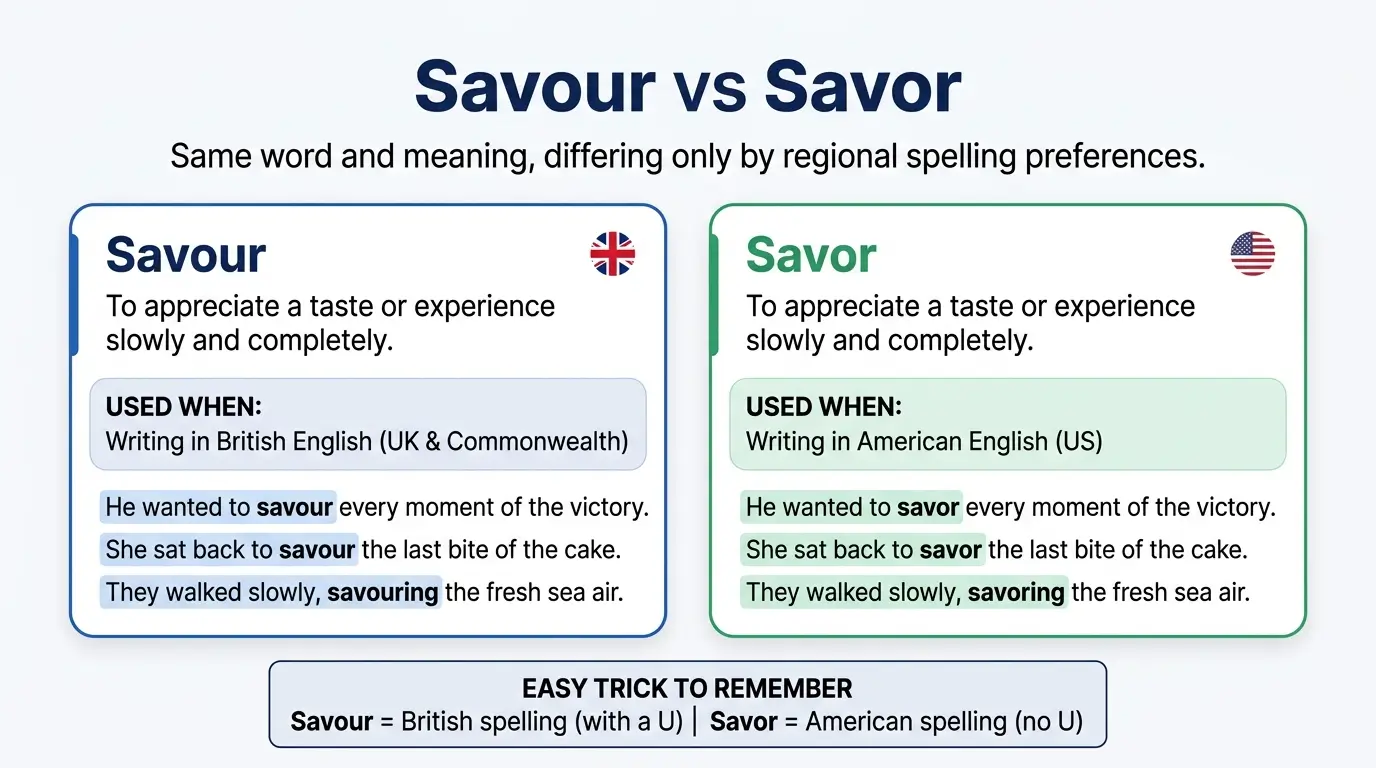
Savour or savor? Both are correct! 🇬🇧 Savour is British English, while 🇺🇸 savor is American English. Same meaning just a different spelling.
Have you ever stopped before writing “savour” or “savor” and wondered which one is correct? You are not alone. Both spellings appear in books, websites, news articles, and everyday writing, but the correct choice depends mainly on the type of English you use.
Savour and savor have the same meaning. Both can mean to enjoy the taste of food or drink slowly, or to enjoy an experience fully.
The main difference is regional spelling: savour is standard in British English, while savor is standard in American English.
This small spelling difference can cause confusion for students, bloggers, writers, and professionals who work with international audiences.
If you are writing for a US audience, savor is usually the right choice. If you are writing in British English, savour is preferred.
In this guide, you will learn the difference between savour and savor, their history, spelling rules, common mistakes, real-life examples, and which form you should use.
Savour or Savor Quick Answer
Both “savour” and “savor” are correct. They are two regional spellings of the same word.
- Savour = British English, including many Commonwealth varieties
- Savor = American English
Both mean to enjoy something deeply or slowly, especially food, drink, or an experience.
Examples:
- British: She stopped to savour every bite.
- American: She stopped to savor every bite.
- British: I want to savour this moment.
- American: I want to savor this moment.
So, neither spelling is wrong. Your choice should match your audience and your chosen style of English.
The Origin of Savour or Savor
The word has a long history. Savour comes from Middle English and Old French, with roots in the Latin word sapor, meaning “taste” or “flavor.” It is also related to the Latin verb sapere, meaning “to taste.”
The older English form was savour. Over time, spelling differences developed between British and American English.
American English became more likely to remove the u from words ending in -our. Noah Webster helped establish many American spelling preferences in the late 18th and early 19th centuries. This created familiar differences such as:
- colour → color
- favour → favor
- honour → honor
- savour → savor
British English generally kept the -our spelling, while American English often adopted the shorter -or form.
The meaning did not change. Only the standard spelling differs.
British English vs American English Spelling
The easiest way to remember the difference is:
British English → savour
American English → savor
Oxford lists savour as the British form and identifies savor as the US English spelling.
| Meaning | British English | American English |
|---|---|---|
| Enjoy food slowly | savour | savor |
| Enjoy an experience | savour | savor |
| Past tense | savoured | savored |
| -ing form | savouring | savoring |
| Third-person form | savours | savors |
| Noun | savour | savor |
More Examples
British English:
He savoured the rich flavor of the dessert.
American English:
He savored the rich flavor of the dessert.
British English:
They savoured every moment of their holiday.
American English:
They savored every moment of their vacation.
The pronunciation is essentially the same, so the difference is mainly visible in writing.
Which Spelling Should You Use?
The best spelling depends on your readers.
For American Readers
Use savor.
Example:
Take your time and savor every moment.
This is the standard American spelling.
For British Readers
Use savour.
Example:
Take your time and savour every moment.
This is the standard British form.
For Commonwealth English
Savour is generally the safer choice in British-based varieties of English. Canadian English, however, commonly uses savour, according to Oxford’s American English dictionary entry.
For a Global Audience
Choose one spelling and stay consistent.
If your website follows American English, use savor throughout your content. If it follows British English, use savour.
Consistency matters more than trying to use both spellings on the same page.
Savour or Savor Comparison Table
| Variation | Standard Form | Main Usage | Example |
|---|---|---|---|
| Savour | British | UK and British-style English | Savour the moment. |
| Savor | American | US English | Savor the moment. |
| Savoured | British past tense | UK | She savoured the meal. |
| Savored | American past tense | US | She savored the meal. |
| Savouring | British -ing form | UK | He is savouring the experience. |
| Savoring | American -ing form | US | He is savoring the experience. |
| Savours | British third-person form | UK | She savours every bite. |
| Savors | American third-person form | US | She savors every bite. |
Common Mistakes with Savour or Savor
1. Thinking One Spelling Is Always Wrong
A common mistake is assuming savour is misspelled because American English uses savor, or vice versa.
Correct: Both are standard regional spellings.
2. Mixing Styles
Avoid switching between the two forms in the same piece of writing.
Inconsistent:
She savored the meal and later savoured the dessert.
Consistent American English:
She savored the meal and later savored the dessert.
Consistent British English:
She savoured the meal and later savoured the dessert.
3. Using “Savior” Instead
Savior is a different word. In American English, it usually refers to a person who saves someone. The spelling saviour is used in British English for that meaning.
So:
- savor = enjoy or appreciate
- saviour/savior = a person who saves
4. Thinking It Only Applies to Food
You can savor or savour more than food.
For example:
She savored the peaceful morning.
They savoured their final day together.
The word can describe enjoying an experience, feeling, or moment fully.
Savour or Savor in Everyday Examples
The word appears in many types of writing.
In Emails
American English:
I hope you take time to savor this achievement.
British English:
I hope you take time to savour this achievement.
In News Writing
American:
Fans gathered to savor the team’s historic victory.
British:
Fans gathered to savour the team’s historic victory.
On Social Media
Savor the little moments. They often become the best memories.
Or:
Savour every moment of the journey.
In Formal Writing
Readers are encouraged to savour the author’s careful use of language.
In American English:
Readers are encouraged to savor the author’s careful use of language.
When Talking About Food
Take your time and savor every bite.
Or in British English:
Take your time and savour every bite.
The word can describe both physical taste and emotional enjoyment.
Savour or Savor Google Trends & Usage Data
Search interest can vary by country because people usually search for the spelling used in their local form of English.
In general:
- Savor is strongly associated with American English.
- Savour is strongly associated with British English and other varieties that retain -our spellings.
- Searches for “savour or savor” often come from people checking which regional spelling is correct.
- Search behavior can also be affected by food, cooking, travel, literature, and phrases such as “savor the moment.”
Dictionary usage confirms the regional pattern: Cambridge labels savour as UK and savor as US, while Oxford similarly identifies savor as the US form.
Google Trends is best understood as relative search interest, not a count of how many times a word is used. Trends can also change over time because of events, popular phrases, and regional search habits.
For SEO, the most useful approach is to match your spelling to your target audience. A US-focused website should normally use savor, while a UK-focused website should use savour.
FAQs About Savour or Savor
Is “savour” or “savor” correct?
Both are correct. Savour is the British spelling, while savor is the American spelling.
Is savour British or American?
Savour is mainly the British English spelling. American English normally uses savor.
Is savor the American spelling?
Yes. Savor is the standard American English spelling.
Do savour and savor mean the same thing?
Yes. Both mean to enjoy the taste of something or to enjoy an experience deeply and fully.
How do you spell savouring in American English?
American English spells it savoring. British English spells it savouring.
How do you spell savoured in American English?
The American spelling is savored. The British spelling is savoured.
Which spelling should I use for a US website?
Use savor. It matches standard American English.
Which spelling should I use for a UK website?
Use savour. It matches standard British English.
Conclusion
So, savour or savor? The answer is simple: both spellings are correct, but they belong to different English varieties. Savour is the standard British form, while savor is the standard American form. The meaning stays the same.
Both words can describe enjoying food, drinks, memories, experiences, or special moments slowly and fully. The difference is mainly a spelling convention that developed between British and American English.
If you write for American readers, choose savor, savored, savoring, and savors. For British English, use savour, savoured, savouring, and savours.
The most important rule is consistency. Pick the spelling that matches your audience, style guide, or publication. Once you know that savour = British and savor = American, this spelling question becomes easy to solve.