Enunciate or Annunciate: Which Word Is Correct?
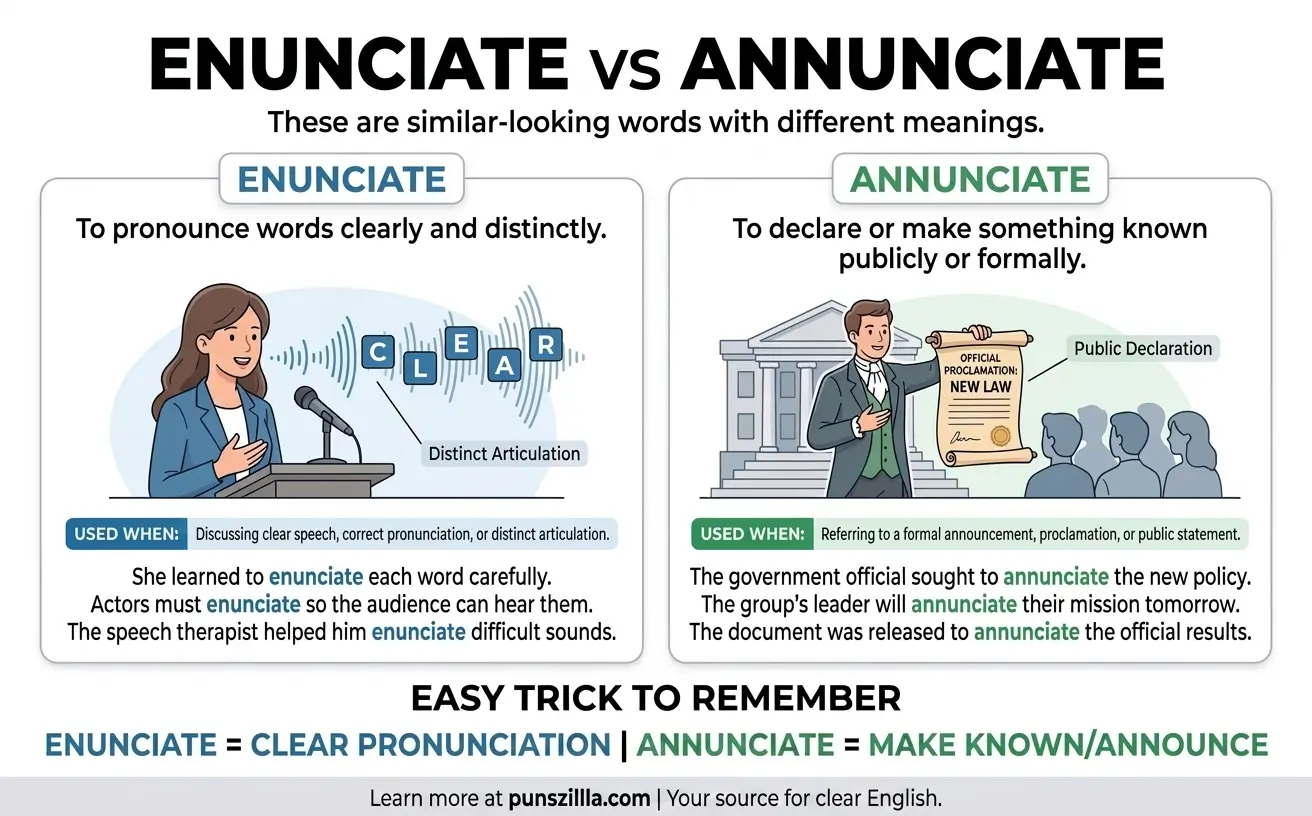
Enunciate is correct when you mean “speak clearly” or “express clearly.” Annunciate is a rare word meaning “announce,” so use enunciate for clear speech.
Have you ever wanted to say “speak clearly” but stopped because you were unsure whether the word was enunciate or annunciate? You are not alone.
These words look and sound similar, and both are linked to the idea of saying or making something known. However, they are not interchangeable.
The word enunciate is the correct choice when you mean to pronounce words clearly or express an idea clearly. For example, “Please enunciate your words.” It can also mean to state an idea, rule, or principle clearly and formally.
Annunciate is a much less common word. It is related to announce and means to announce or bring news of something. It is not the usual word for clear speech.
This guide explains enunciate or annunciate, their meanings, origins, spelling, examples, common mistakes, and which word you should use.
Enunciate or Annunciate Quick Answer
Enunciate is the correct word when you mean to pronounce words clearly or to express an idea clearly.
- Correct: Please enunciate your words.
- Correct: The speaker enunciated the main points clearly.
- Less common: The official annunciated the news.
Annunciate does exist, but it is rare and means to announce or bring news of something. It is related to announce and annunciation.
Quick comparison
| Word | Main meaning | Commonness | Example |
|---|---|---|---|
| Enunciate | Speak or express clearly | Common | Please enunciate each word. |
| Annunciate | Announce or declare | Rare | The message was annunciated publicly. |
| Announce | Make something known | Very common | They announced the results. |
Easy rule: If you mean “say clearly,” use enunciate. If you mean “announce,” use announce in most modern writing.
The Origin of Enunciate or Annunciate
The two words have related Latin roots, which helps explain why they look so similar.
Enunciate comes from Latin enuntiare, meaning “to speak out,” “say,” “express,” or “declare.” The English verb appeared in the 1620s with the meaning “declare” or “express.” Its meaning connected with clear pronunciation developed later, around 1759.
Annunciate comes from Latin annuntiare, meaning “to announce” or “relate.” English records the verb from the 1530s. The word was connected with bringing news or making something known.
Both words ultimately connect with Latin nuntius, meaning “messenger.” This shared history helps explain their similar spelling and meaning.
The key difference developed through their prefixes and usage:
- en- / ex- → connected with speaking or bringing something out
- an- / ad- → connected with bringing news or making something known
Over time, enunciate became strongly associated with clear speech and clear expression, while annunciate remained uncommon.
British English vs American English Spelling
There is no major British-American spelling difference between enunciate and annunciate. Both varieties use the same spellings.
Cambridge gives the same spelling and essentially the same pronunciation for enunciate in British and American English.
| Feature | British English | American English |
|---|---|---|
| Clear speech | enunciate | enunciate |
| Announce | announce / rarely annunciate | announce / rarely annunciate |
| Spelling | enunciate | enunciate |
| Pronunciation | /ɪˈnʌn.si.eɪt/ | /ɪˈnʌn.si.eɪt/ |
| Common choice | enunciate | enunciate |
So, unlike words such as colour/color or organise/organize, this is not a British-versus-American spelling issue.
The confusion comes mainly from the similar appearance and shared Latin background of the words.
Which Spelling Should You Use?
For American English
Use enunciate when talking about clear pronunciation or clear expression.
Please enunciate your answer.
If you mean “make something known,” use announce.
The company announced its new policy.
For British English
The same advice applies.
The actor enunciated every line clearly.
For news or information:
The government announced the new plan.
For Commonwealth English
English users in countries such as Canada, Australia, and New Zealand will also normally understand enunciate as the word for clear speech.
For global English
If your writing is for an international audience, enunciate and announce are the safest choices.
Use annunciate only when you have a specific reason to use the rare word.
Common Mistakes with Enunciate or Annunciate
Mistake 1: Using annunciate for clear speech
Incorrect or unusual:
Please annunciate your words.
Better:
Please enunciate your words.
Enunciate specifically has the meaning of pronouncing words or parts of words clearly.
Mistake 2: Thinking enunciate means announce only
Enunciate can mean to express something clearly or formally, but it also commonly refers to clear pronunciation.
The professor enunciated the principle clearly.
Mistake 3: Treating the words as spelling variants
They are different words, not British and American versions of the same word.
Mistake 4: Using annunciate when announce is better
Because annunciate is rare, announce is usually clearer and more natural.
The company announced the results.
This is better than:
The company annunciated the results.
Enunciate or Annunciate in Everyday Examples
In an email
Please enunciate the instructions clearly during the presentation.
In a classroom
The teacher asked the student to enunciate each word.
In a speech
The speaker enunciated every sentence slowly and clearly.
In formal writing
The report clearly enunciated the principles behind the new policy.
Cambridge confirms that enunciate can describe both clear pronunciation and the clear or formal expression of an idea.
In news writing
For reporting new information, announce is usually the natural choice:
The minister announced a new education policy.
On social media
I need to enunciate better when I speak on camera!
This is a natural use because the person is talking about clear pronunciation.
Enunciate or Annunciate Google Trends & Usage Data
Searches for “enunciate or annunciate” are mainly driven by spelling and word-choice confusion. People often search the two words together because they look similar and have related meanings.
The important usage pattern is clear:
- Enunciate is used in speech, pronunciation, presentations, acting, teaching, and formal explanations.
- Annunciate is much rarer.
- Announce is the normal modern choice when someone wants to make news or information public.
- Enunciate appears in both British and American English dictionaries with the same core meanings.
Google Trends can show changing search interest by country and time, but search interest should not be confused with actual word frequency.
A search for “enunciate or annunciate” often reflects someone checking which word is correct rather than evidence that both words are equally common.
For practical writing, enunciate is the clear winner when discussing pronunciation.
Enunciate vs Annunciate: Side-by-Side Comparison
| Word | Meaning | Typical use | Example |
|---|---|---|---|
| Enunciate | Pronounce clearly | Speech and pronunciation | Enunciate every syllable. |
| Enunciate | Express clearly | Ideas and principles | She enunciated her position. |
| Annunciate | Announce or bring news | Rare/formal usage | The news was annunciated. |
| Announce | Make something known | Everyday English | They announced the winner. |
The simplest way to remember
Enunciate = speak clearly.
Announce = make news known.
Annunciate = a rare word related to announce.
FAQs About Enunciate or Annunciate
Is it enunciate or annunciate?
Enunciate is the correct and common choice when you mean to pronounce words clearly. Annunciate is a rare word meaning to announce or bring news.
Does enunciate mean speak clearly?
Yes. Enunciate means to pronounce words or parts of words clearly.
Is annunciate a real word?
Yes. Annunciate is a real but uncommon English word related to announcing or bringing news.
Is enunciate the same as announce?
No. They overlap in the idea of expressing or making something known, but they are normally used differently. Enunciate often means to speak or express clearly, while announce means to make information public.
Is enunciate British or American?
It is used in both British and American English. The spelling does not change between the two varieties.
What is the noun form of enunciate?
The noun is enunciation. It can mean the act of pronouncing words clearly or the clear expression of an idea.
Conclusion
When choosing between enunciate or annunciate, the right word depends on what you want to say. If you mean to pronounce words clearly, choose enunciate. It is also correct when you mean to express an idea, principle, or position clearly and formally.
Annunciate is a real English word, but it is uncommon. It is related to announce and has the sense of bringing news or making something known. In everyday modern English, announce is usually a better choice for that meaning.
There is also no important British-versus-American spelling difference here. Both varieties use enunciate for clear speech.
The easiest rule is simple: enunciate = speak clearly; announce = make something known; annunciate = rare word related to announcing.
If you are writing an email, essay, article, report, or professional document, using enunciate for clear speech will almost always be the safest choice.