Furthest or Farthest: Which Word Is Correct?
Have you ever wondered whether to write furthest or farthest? Both words are correct, and both can describe the greatest distance. But they can have slightly different uses. This can make the choice hard for English learners and writers.
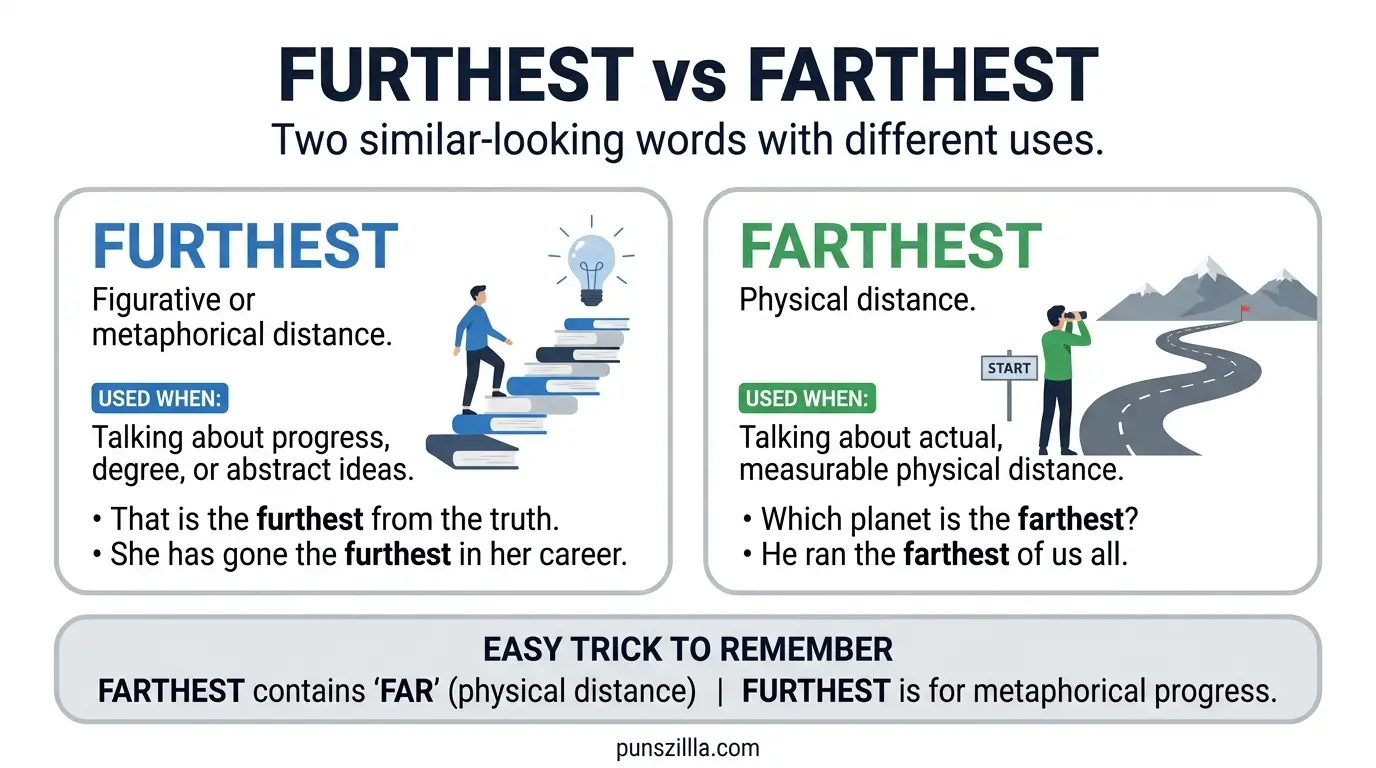
The good news is that you do not need to worry too much. Farthest often refers to physical distance, while furthest can refer to both physical distance and an extra degree of progress.
However, these meanings overlap, and many people use the two words in the same way.
People search for “furthest or farthest” because they want to know which word is right in schoolwork, emails, reports, and daily speech.
They may also want to know whether British and American English follow different rules.
In this guide, you will learn the meaning of each word, how to use it, and which spelling is best for your readers. You will also see clear examples, common mistakes, and answers to popular questions.
The simple rule is this: use farthest when you want to stress distance, and use furthest when you mean distance or the greatest degree of progress. When the meaning overlaps, either word may work.
Furthest or Farthest Quick Answer
Both furthest and farthest are correct English words. They are the superlative forms of far, which means they describe the greatest distance or degree.
- Farthest: Often used for physical distance.
- Furthest: Used for physical distance and figurative ideas, such as progress or development.
Examples of Farthest
- The school is the farthest building from my house.
- Which planet is farthest from the Sun?
- She ran the farthest in the race.
Examples of Furthest
- We have gone the furthest in our research.
- This plan takes us furthest toward our goal.
- His office is the furthest from the main entrance.
Quick tip: If you are talking about a place or measurable distance, farthest is a good choice. If you are talking about progress, effort, or an idea, furthest is often a natural choice. In many sentences, both words are acceptable.
The Origin of Furthest or Farthest
Both words come from the adjective far. This word has a long history in English and describes something that is at a great distance.
English forms comparative and superlative words in different ways. For example:
- Far → farther → farthest
- Far → further → furthest
The word farthest is linked to the distance-related form farther. The word furthest is linked to further, which can refer to distance as well as progress, development, or degree.
Over time, these forms began to overlap. Today, many speakers use furthest and farthest for physical distance. Some writers still prefer farthest for literal distance and furthest for figurative meaning.
This difference is a useful guide, but it is not a strict rule in every situation. Both forms are established parts of modern English.
British English vs American English Spelling
British and American English both accept furthest and farthest. These words do not follow the common spelling differences seen in words such as colour and color.
The main difference is often about style and usage, not spelling.
| Feature | British English | American English |
|---|---|---|
| Correct spelling | Furthest and farthest | Furthest and farthest |
| Physical distance | Both are used | Both are used |
| Figurative progress | Furthest is common | Furthest is common |
| Formal writing | Both are accepted | Both are accepted |
| Preferred choice | Depends on context | Depends on context |
British English Examples
- The station is the farthest point on this road.
- We have taken the project furthest in our team.
- She lives the furthest away from the office.
American English Examples
- Which store is the farthest from here?
- This idea takes the project furthest.
- He ran the farthest during practice.
These examples show common usage, not fixed national rules. Both words appear in British and American writing.
For more detail, consult the Cambridge Dictionary, which explains the meaning and use of furthest.
Which Spelling Should You Use?
Your best choice depends on what you mean and who will read your writing.
If You Write for American Readers
Use farthest when you want to describe physical distance. For example:
“The airport is the farthest place on the map.”
Use furthest for progress or degree:
“This plan will take our work furthest.”
You can also use either word for physical distance when the sentence sounds natural.
If You Write for British or Commonwealth Readers
Both words are correct in British English and in other varieties of English, including Australian and Canadian English.
For a physical distance, farthest is clear and direct. For progress or an abstract idea, furthest is often a good fit.
If You Write for a Global Audience
Keep your wording simple and clear. Use farthest for physical distance and furthest for progress or degree when that distinction helps.
For example:
- “This is the farthest village from the city.”
- “This is the furthest we have come in our work.”
Do not change between the two words without a reason in the same piece of writing. Consistent usage makes your work easier to read.
Common Mistakes with Furthest or Farthest
Many writers confuse these words because their meanings overlap. Here are common mistakes and how to avoid them.
Mistake 1: Thinking One Word Is Always Wrong
Incorrect idea: “Furthest is wrong in American English.”
Correction: Both words are accepted in American English.
Mistake 2: Using Farther as a Superlative
Incorrect: “This is the farther point from town.”
Correct: “This is the farthest point from town.”
Use farther to compare two distances. Use farthest to describe the greatest distance among three or more options, or across a wider set.
Mistake 3: Using Further Instead of Furthest in Every Case
Incorrect: “This is the further we have ever reached.”
Correct: “This is the furthest we have ever reached.”
Further is the comparative form. Furthest is the superlative form.
Mistake 4: Ignoring the Meaning of the Sentence
If you are discussing progress, furthest may express your meaning more clearly.
Example: “Of all the teams, ours has gone the furthest.”
For a physical location, farthest may be clearer.
Example: “The farthest house is near the hill.”
Mistake 5: Assuming British and American Spelling Rules Apply
Words such as organise and organize differ by region. Furthest and farthest do not work that way. Both are correct in both varieties.
Furthest or Farthest in Everyday Examples
The right word depends on your sentence and its meaning. Here are examples from common types of writing.
In Emails
“Your office is the farthest from the main entrance.”
“This option will take us furthest toward our goal.”
Both sentences are clear and suitable for work emails.
In News Reports
“The storm reached the farthest parts of the region.”
“The new policy goes furthest in addressing the problem.”
The first sentence describes physical reach. The second describes the extent of an action.
On Social Media
“I walked the farthest today!”
“This is the furthest I have ever come with my fitness goals.”
Both forms sound natural in casual writing.
In Formal Writing
“The village lies at the farthest point from the capital.”
“This study takes the discussion furthest by examining new evidence.”
In formal writing, choose the word that best matches your meaning. You do not need to avoid either word.
In Schoolwork
“Which runner travelled the farthest?”
“Which argument takes the discussion furthest?”
These examples help show the difference between physical distance and progress in an idea.
Furthest or Farthest Google Trends and Usage Data
People may search for “furthest or farthest” when they are unsure which word to use. Search interest can change by country, season, and writing context.
However, it is important to separate search interest from actual word usage. Google Trends shows relative search interest for selected terms over a chosen time and region.
It does not provide a complete count of how often each word appears in books, news stories, or everyday speech.
Without checking a specific date range and region, it would be misleading to claim that one word is more popular in the United States, the United Kingdom, or another country.
Here is a practical guide to the contexts in which each word is often useful:
| Context | Recommended word | Example |
|---|---|---|
| Physical distance | Farthest | The farthest shop is closed. |
| Travel distance | Farthest | We drove the farthest today. |
| Progress | Furthest | We have gone the furthest. |
| Development | Furthest | This version takes the idea furthest. |
| General comparison | Either | Which place is furthest away? |
For actual search-interest comparisons, visit Google Trends and compare “furthest” with “farthest.” Select your country and time range before drawing conclusions.
Remember that a word can be widely used without being searched more often. Search trends show what people look for, not every word they use.
Furthest vs Farthest – Comparison Table
Use this table for a quick review of the two words.
| Feature | Furthest | Farthest |
|---|---|---|
| Word type | Superlative of far | Superlative of far |
| Physical distance | Correct | Correct |
| Figurative progress | Common choice | Also possible in some contexts |
| British English | Correct | Correct |
| American English | Correct | Correct |
| Example | We went the furthest. | We travelled the farthest. |
| Main tip | Useful for distance and degree | Often preferred for physical distance |
The key difference is one of emphasis. Farthest often points to physical distance, while furthest often points to progress or degree. The two words can still be used in the same way in many sentences.
FAQs About Furthest or Farthest
1. Is furthest or farthest correct?
Both are correct. Farthest often refers to physical distance, while furthest can refer to physical distance or progress.
2. What is the difference between furthest and farthest?
The main difference is how people use them. Farthest often describes the greatest physical distance. Furthest is also used for ideas, progress, and development. Their meanings overlap.
3. Is furthest British or American?
Both British and American English use furthest. It is not limited to one country or spelling system.
4. Do Americans use farthest or furthest?
Americans use both words. Farthest is common for physical distance, while furthest is often used for progress or degree. Both can describe distance.
5. Is it the furthest away or the farthest away?
Both phrases are correct. For example, you can say, “That house is the furthest away” or “That house is the farthest away.”
6. Should I say furthest from or farthest from?
Both are correct when describing distance. For example, “The school is farthest from my home” and “The school is furthest from my home” are both acceptable.
7. What is the difference between farther, further, farthest, and furthest?
Farther and further are comparative forms. Farthest and furthest are superlative forms.
- Farther: My house is farther away than yours.
- Further: We need further discussion.
- Farthest: This is the farthest town.
- Furthest: This is the furthest we have progressed.
8. Which word should I use in formal writing?
Use the word that best fits your meaning. Choose farthest for physical distance if you want a clear distinction. Choose furthest for progress or degree. Both are accepted in formal English.
Conclusion: Furthest or Farthest?
The choice between furthest and farthest is easier once you understand how the words work. Both are correct English words, and both can describe the greatest distance.
You do not need to worry that one is British and the other is American because both forms are used in both varieties of English.
As a simple guide, use farthest when talking about physical distance. For example, “This is the farthest shop from my house.”
Use furthest when talking about progress, ideas, or how much something has developed. For example, “This plan takes us furthest toward our goal.”
These are helpful guidelines, not strict rules. In many sentences, either word is correct. The most important thing is to make your meaning clear and choose words that sound natural to your readers.
If you write for a global audience, keep your usage consistent and avoid changing words without a reason. When you are unsure, check a trusted dictionary for examples.
With practice, you will find it easier to choose the right word in emails, schoolwork, reports, and everyday conversations.