
Conversing or Conversating: Which Is Correct?
Have you ever wondered whether to write conversing or conversating? Both words describe talking with someone. However, they differ in standard usage and formality.
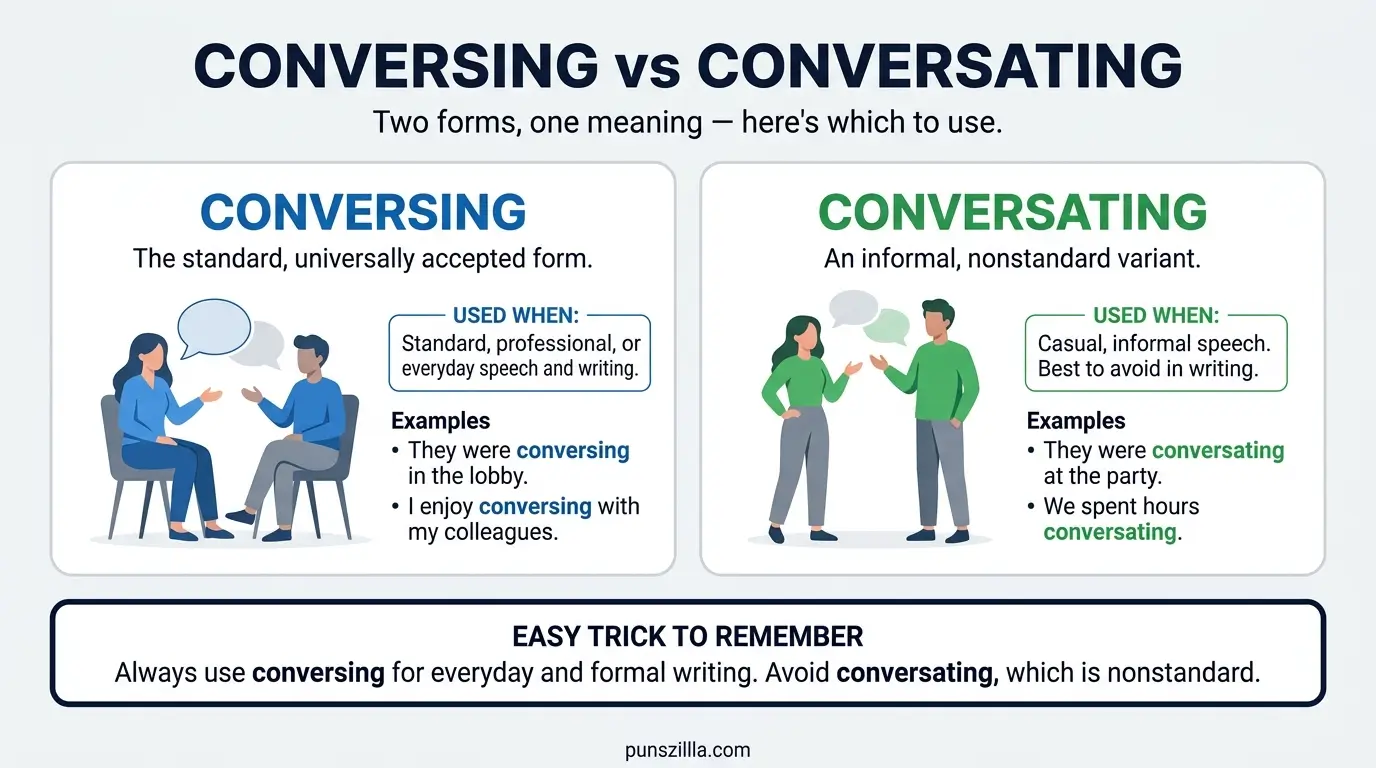
Conversing is the standard, widely accepted choice. Conversating is a nonstandard alternative that appears in informal English.
Both forms can communicate the idea of having a conversation, but they are not equally suitable for every situation.
People often search for “conversing or conversating” because the words look similar. They also sound natural in everyday speech. This can make choosing the right word confusing, especially for English learners.
The good news is that the rule is simple. Use conversing in school assignments, professional emails, academic writing, and formal documents. You may encounter conversating in casual conversations, online posts, and informal speech.
In this guide, you will learn what each word means, where the difference comes from, and which form to use. You will also find practical examples, common mistakes, and answers to frequently asked questions.
Conversing or Conversating Quick Answer
Quick Answer: Conversing is the standard form and the safest choice for almost every situation. Conversating is also used in English, but dictionaries label conversate as nonstandard.
Use conversing in formal writing, professional communication, and exams. Reserve conversating for informal contexts when appropriate.
Examples of Conversing
- The students were conversing quietly in the library.
- I enjoy conversing with people from different cultures.
- They spent the evening conversing about their future plans.
Examples of Conversating
- The friends were conversating outside the café.
- We spent the afternoon conversating about our favorite movies.
- They were conversating casually while waiting for the bus.
These examples illustrate how people use both forms. However, the second form may sound incorrect or unsuitable to readers who follow standard formal English.
For reliable formal writing, choose conversing.
The Origin of Conversing and Conversating
Understanding the history of these words helps explain their different status.
Where Does Conversing Come From?
Conversing comes from the verb converse, which means to talk with someone. The word has roots in Latin and Old French.
Oxford Learner’s Dictionaries traces converse to the Latin conversari, meaning to keep company with others. The modern sense of talking with someone developed over time.
The word conversing is the standard -ing form of converse.
For example:
- She is conversing with her teacher.
- They enjoy conversing after work.
Where Does Conversating Come From?
Conversating comes from conversate, a nonstandard verb meaning to exchange thoughts through speech.
Merriam-Webster records conversate as a word and traces its first known use to the early nineteenth century. It identifies the verb as nonstandard.
Therefore, conversating is not simply a random spelling mistake. It is an established, though nonstandard, form used by some English speakers.
The important distinction is not whether people use the word. It is whether the word suits the situation.
For more information, consult the Merriam-Webster entry for conversate and the Oxford Learner’s Dictionaries entry for converse.
Difference Between Conversing and Conversating
The main difference is standard usage, not meaning.
Both words can describe people talking or exchanging ideas. However, conversing is the established standard form, while conversating is considered nonstandard.
When Should You Use Conversing?
Use conversing when you want clear, standard English.
It works well in:
- School assignments and essays
- Business emails and reports
- Academic and professional documents
- News articles and formal writing
- Everyday conversations where standard wording is preferred
Example: “The manager was conversing with the client about the project.”
This sentence sounds natural and professional.
When Is Conversating Used?
Conversating appears in informal speech and writing. Some speakers use it as an alternative to conversing.
However, its nonstandard status means it may distract readers in formal settings. Some people may consider it incorrect, even when they understand the intended meaning.
Example: “We were conversating about the latest movie.”
The meaning is understandable, but “We were conversing about the latest movie” is the safer standard version.
Comparison Table
| Word | Use when | Example sentence |
|---|---|---|
| Conversing | You want standard English | They were conversing during lunch. |
| Conversating | Informal usage where the nonstandard form is acceptable | They were conversating during lunch. |
Easy rule: Choose conversing for standard English. Recognize conversating as a nonstandard alternative.
Which Word Should You Use?
Your choice depends on your audience and purpose. In most cases, conversing is the better option.
For American English
American English uses conversing as the standard form. You may also encounter conversating in informal speech and online discussions.
For professional writing, use conversing.
For British English and Commonwealth Countries
In British English and Commonwealth English, conversing is also the safe standard choice. English learners in Pakistan, India, Australia, and other Commonwealth countries can use it confidently.
Do not treat conversating as a standard British or American spelling variant. The difference concerns usage and formality, not regional spelling.
For IELTS and TOEFL
Use conversing in essays, speaking-test responses, and other exam-related writing when the word fits naturally.
IELTS and TOEFL reward clear, appropriate language. Choosing standard vocabulary helps you avoid unnecessary wording concerns.
You can often use simpler alternatives, such as talking or having a conversation, when they express your meaning more naturally.
For Business Emails
Choose conversing in formal business communication. In many emails, discussing or speaking with may sound even more natural.
For example:
“The team was conversing about the new proposal.”
A more direct alternative is:
“The team was discussing the new proposal.”
Common Mistakes with Conversing or Conversating
Writers sometimes confuse these forms or use them in unsuitable contexts. The table below explains common problems.
| Wrong | Right | Why |
|---|---|---|
| We was conversing. | We were conversing. | The subject “we” takes “were.” |
| She is conversate with him. | She is conversing with him. | Use the standard verb form. |
| They are conversing about the issue yesterday. | They were conversing about the issue yesterday. | Match the tense to the past time. |
| The employees were conversating during the formal meeting. | The employees were conversing during the formal meeting. | The standard form suits formal writing. |
| I enjoy conversating with my clients. | I enjoy conversing with my clients. | The standard form is safer professionally. |
| We were conversing each other. | We were conversing with each other. | Use “with” when describing people conversing together. |
Remember that grammar and word choice are separate issues. A sentence can have correct grammar but still use a nonstandard word.
Conversing or Conversating in Everyday Examples
Both forms may appear in informal settings, but standard English remains the better choice when clarity and professionalism matter.
| Context | Example |
|---|---|
| I enjoyed conversing with you about the new project. | |
| Thank you for conversing with our support team. | |
| News headline | Community Leaders Converse About Local Development |
| News headline | Residents Spend the Evening Conversing at a Community Event |
| Social media | I love conversing with people who share my interests. |
| Social media | We were conversating about our favorite songs last night. |
| Formal writing | The researchers were conversing about their findings. |
| Formal writing | The participants spent time conversing before the interview began. |
These examples show the difference in tone. Conversing fits standard written English, while conversating may suit casual dialogue when reflecting a speaker’s natural wording.
In headlines, converse may be more concise than either conversing or conversating.
Conversing or Conversating Google Trends and Usage Data
No live Google Trends comparison or Google Books Ngram results were supplied for this article. Therefore, this section does not claim exact search volumes, popularity rankings, percentages, or historical frequency figures.
Based on dictionary usage guidance, conversing is the safer standard form. Conversating is recognized but marked nonstandard by Merriam-Webster.
General Usage Comparison
| Word | More common in | Where you see it |
|---|---|---|
| Conversing | Standard written and spoken English | Essays, professional communication, books, and everyday conversation |
| Conversating | Informal usage among some speakers | Casual speech, social media, and informal dialogue |
These descriptions reflect general usage guidance, not a measured comparison of search popularity. Regional and community usage can vary.
Check It Yourself
Check It Yourself:
- Open Google Trends and compare “conversing” with “conversating.” Select your country and a suitable time range.
- Change the search category or location to explore differences in search interest. Remember that Trends reports relative interest, not total search volume.
- Visit Google Books Ngram Viewer and compare both terms across published books. Check the selected corpus and dates before drawing conclusions.
Search interest and published-book frequency measure different things. Neither alone proves which word is correct.
Comparison Table
| Word | Type/Meaning | Region or Status | Example | Formality | Memory Trick |
|---|---|---|---|---|---|
| Conversing | Talking or exchanging ideas | Standard English | They were conversing after class. | Formal or informal | Converse → conversing |
| Conversating | Talking or exchanging ideas | Nonstandard form | They were conversating after class. | Mainly informal | Conversate is marked nonstandard |
The two words can communicate a similar idea. The main difference is their acceptance in standard English.
FAQs
Is conversing or conversating correct?
Conversing is the standard choice. Conversating is a recognized but nonstandard alternative. Use conversing in formal writing, schoolwork, and professional communication. It is widely understood and avoids the objections that some readers have to conversating.
Is conversating a real word?
Yes, conversating is an established form derived from conversate. Merriam-Webster lists conversate as a nonstandard verb. However, being recorded in a dictionary does not mean a word is appropriate for every context.
What is the difference between conversing and conversating?
Both words describe talking with someone or exchanging ideas. The difference is their status in standard English. Conversing is the standard form, while conversating is nonstandard. For most writing, the first option is the safer choice.
Is conversating grammatically incorrect?
It is better described as nonstandard rather than automatically ungrammatical in every context. People use it, and its meaning is usually clear. However, formal writing generally favors conversing, which follows standard usage.
Can I use conversating in an essay?
You should generally avoid conversating in academic essays. Use conversing, talking, or discussing, depending on your meaning. These choices are more appropriate for formal work and are less likely to distract your reader.
Is conversing more formal than conversating?
Yes, conversing is the more appropriate choice for formal contexts. It is the standard form of the verb converse. Conversating is nonstandard and is better avoided in professional documents, academic writing, and formal communication.
What is another word for conversing?
Common alternatives include talking, speaking, chatting, and discussing. The best choice depends on context. Chatting suggests informal conversation, while discussing usually means talking about a particular topic.
Conclusion
Key Takeaways:
- Conversing is the standard form and the safest choice for most situations.
- Conversating is a recognized but nonstandard alternative.
- Use conversing in academic writing, business emails, and formal communication.
- Choose words based on your audience, purpose, and desired tone.
When deciding between conversing or conversating, remember that the difference is not simply about spelling. Both forms can express the idea of talking with someone, but they have different levels of acceptance in standard English.
For school assignments, IELTS or TOEFL preparation, workplace communication, and published articles, conversing is the better option. It is clear, established, and suitable for formal and informal writing.
You may encounter conversating in casual conversations or on social media. Understanding the word can help you recognize how different speakers use English. However, you do not need to use it yourself.
If you want a simpler alternative, talking often works well. For a more specific meaning, choose discussing when people are exchanging ideas about a topic.
Ultimately, use conversing when you want a reliable standard-English choice. This simple rule will help you communicate clearly and confidently.