
Cankles or Kankles: Which Is Correct?
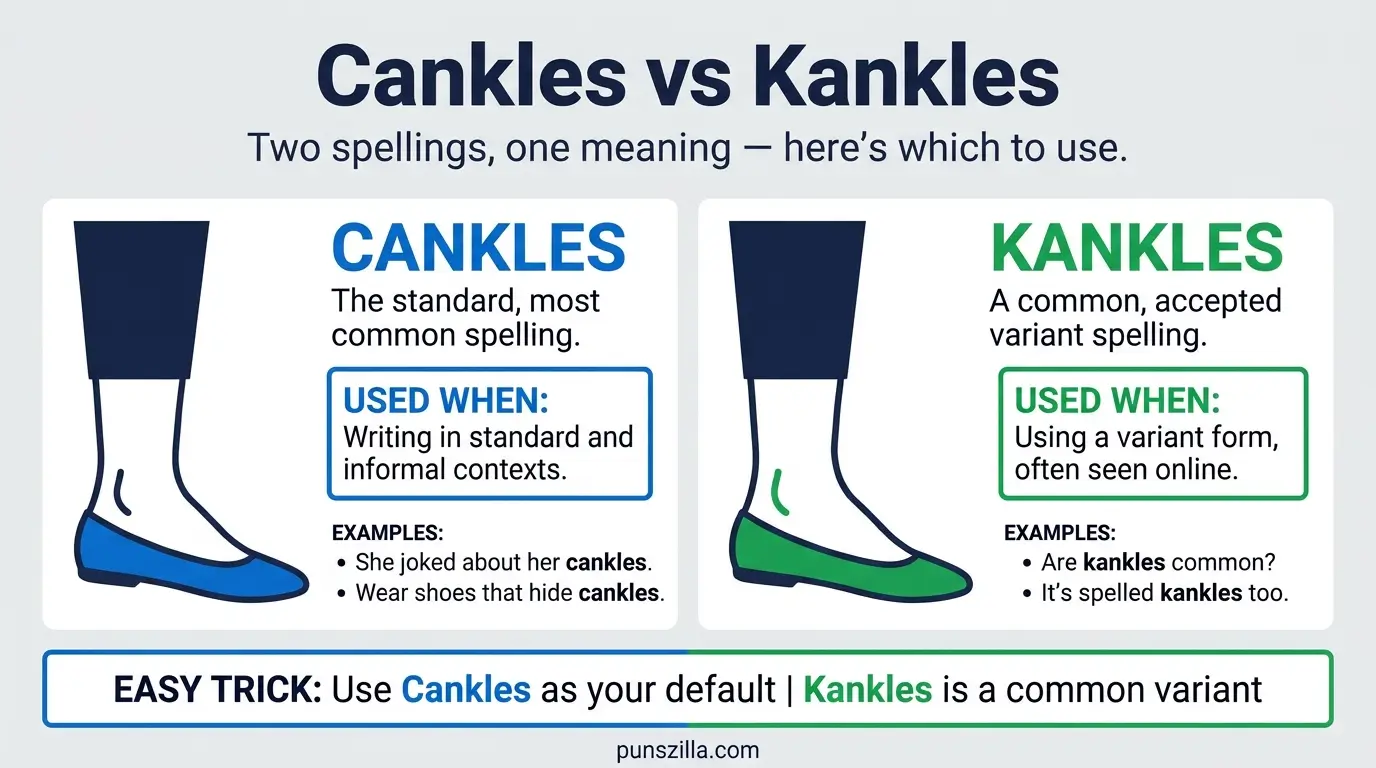
Cankles is the preferred spelling, combining “calf” and “ankle.” Kankles is a less common alternative spelling.
Have you ever wondered whether to write cankles or kankles? These words look similar, and both appear in informal English.
However, cankles is the more widely recognized spelling in dictionaries and general writing.
The word cankles combines two body-part words: calf and ankle. It describes an ankle that blends into the calf without a clear outline.
People often use it in casual conversations, online discussions, and humorous posts.
But is kankles completely wrong? Not necessarily. Some word references list it as an alternative spelling. Still, it is much less established than cankles.
This guide explains the difference between cankles and kankles. You will learn their meanings, origins, correct usage, and common mistakes. You will also see examples for everyday conversations and professional writing.
Whether you are learning English or checking a spelling before publishing content, the rule is simple: use cankles for the most widely recognized form.
Remember that this is an informal word, so a more neutral phrase may be better in formal or sensitive situations.
Cankles or Kankles Quick Answer
Quick Answer: Cankles is the preferred spelling in standard dictionary usage. It is an informal blend of calf and ankle.
Kankles is a less common alternative spelling, not a separate word with a clearly different meaning. Choose cankles when writing for a general English-speaking audience.
Examples of Cankles
- The article explained the informal meaning of cankles.
- She searched online to learn what the word cankles meant.
- The writer used a more neutral phrase instead of cankles.
Examples of Kankles
- I saw the word kankles in an informal online discussion.
- The reader asked whether kankles was another spelling of cankles.
- Some online writers use kankles, but cankles is more widely recognized.
These examples show how both spellings may appear. However, the first spelling is the safer choice for general writing.
The Origin of Cankles or Kankles
The word cankle is a blend of calf and ankle. A blend combines parts of two words to create a new word. The plural form is cankles.
The American Heritage Dictionary and Collins English Dictionary recognize cankle and explain its connection to these two body parts. The term is informal rather than a standard medical diagnosis.
The spelling reflects how the word was formed. It takes the beginning of calf and combines it with ankle.
The result describes the appearance of the lower leg when the calf and ankle lack a clear distinction.
The alternative kankle uses a different first letter. It appears in some word references as an alternative form. However, cankle has stronger recognition in established dictionary entries.
The exact history of the alternative spelling is less clear. Avoid assuming that it has a separate origin or meaning without reliable evidence.
For reference, consult the American Heritage Dictionary and Collins English Dictionary.
Correct Spelling vs Common Alternative Spelling
The main difference between cankles and kankles is how widely each spelling is recognized.
| Word | Use when | Example sentence |
|---|---|---|
| Cankles | You want the widely recognized spelling | The writer explained the meaning of cankles. |
| Kankles | You are discussing an alternative spelling found online | The reader wondered whether kankles was also used. |
When Should You Use Cankles?
Use cankles in general writing when you mean the informal term for ankles that blend into the calves.
It is the better choice for articles, explanations, and discussions about the word itself. It is also the spelling readers are more likely to recognize in dictionaries.
Examples:
- The dictionary explains the meaning of cankles.
- The social media post used the word cankles humorously.
- The writer explained why cankles is an informal expression.
When Does Kankles Make Sense?
Use kankles only when you have a specific reason to reproduce that spelling. For example, you might quote a post, discuss an alternative form, or explain a spelling variation.
Do not assume it is the preferred spelling simply because you see it online.
Examples:
- The comment used the spelling kankles.
- The student asked about the alternative form kankles.
- The editor changed kankles to cankles for consistency.
Easy rule to remember: Choose cankles for ordinary writing. Reserve kankles for discussions where the alternative spelling matters.
Which Spelling Is Correct?
For most everyday writing, cankles is the recommended choice. It is the established dictionary form, while kankles is less common.
For US Readers
American readers are most likely to recognize cankles as the familiar spelling. Use it in blog posts, captions, and informal explanations.
For professional writing, consider whether the term is necessary. A phrase such as thick ankles or swelling around the ankles may be more appropriate, depending on the intended meaning.
For UK and Commonwealth Readers
The same general advice applies in British, Australian, Canadian, and other Commonwealth English contexts. There is no established US-versus-UK spelling distinction between cankles and kankles.
Use cankles when you need the informal term. Choose a neutral description when writing for a formal or sensitive audience.
For IELTS, TOEFL, and Business Writing
Neither spelling is a useful choice for formal academic writing unless you are discussing the word itself.
In IELTS and TOEFL essays, prefer precise descriptions. In business emails, avoid slang unless the context clearly calls for it.
For example, write “swelling around the ankles” when describing a possible physical symptom. This phrase is clearer and more neutral than cankles.
Common Mistakes with Cankles or Kankles
Writers often confuse the preferred spelling with informal alternatives. These mistakes are easy to avoid.
| Wrong or less suitable | Right or better choice | Why |
|---|---|---|
| Using kankles in ordinary writing | Cankles | Cankles is more widely recognized. |
| Treating both spellings as equally common | Prefer cankles | The dictionary evidence favors cankles. |
| Calling cankles a medical diagnosis | Use a precise medical description when needed | Cankles is an informal term. |
| Assuming kankles has a different meaning | Treat it as an alternative spelling | No clear difference in meaning is established. |
| Using cankles in a formal medical report | Describe the actual symptom | Neutral wording is more precise. |
| Assuming every thick ankle is caused by body fat | Describe the appearance without guessing the cause | Ankle swelling can have different causes. |
Remember that spelling and meaning are not the only concerns. Context matters, too. A word can be understood but still sound unsuitable for a particular audience.
Cankles or Kankles in Everyday Examples
The word cankles usually appears in casual contexts. However, the best wording depends on your audience and purpose.
| Context | Example |
|---|---|
| “I found the word cankles while checking an informal expression.” | |
| “Could you replace kankles with cankles in the draft?” | |
| News headline | “Cankles: What Does This Informal Term Mean?” |
| News headline | “Why Some Writers Prefer Neutral Language for Body Descriptions” |
| Social media post | “I came across the word cankles and wanted to check its meaning.” |
| Social media post | “Is kankles another spelling of cankles?” |
| Formal writing | “The text uses the informal term cankles to describe the lower leg.” |
| Formal writing | “The patient reported swelling around the ankles.” |
Notice that the final example uses a more precise description. This is especially important when discussing health concerns rather than appearance.
Cankles or Kankles – Google Trends and Usage Data
Cankles is the more established spelling in dictionary usage. Kankles appears as an alternative form, but it has less recognition in mainstream references.
These observations do not establish exact search popularity. No live Google Trends comparison or numerical search data is provided here.
Which Spelling Is More Common?
| Word | More common in | Where you see it |
|---|---|---|
| Cankles | General informal English | Dictionaries, articles, conversations, and social media |
| Kankles | Less common informal usage | Alternative spellings, online comments, and word discussions |
How Usage Varies by Context
- News and articles: Cankles is the safer spelling when the term is needed.
- Formal writing: A neutral, descriptive phrase is often more suitable.
- Casual speech: People may encounter either spelling, especially online.
- Social media: Informal spellings can spread without becoming standard forms.
- Regional English: There is no well-established regional spelling split between these forms.
Check It Yourself
Follow these three steps to compare their usage:
- Open Google Trends and compare the search terms “cankles” and “kankles.” Select your target country and a suitable time range.
- Check the results separately for each country. Compare search interest rather than treating it as an exact count of searches.
- Open Google Books Ngram Viewer and compare both terms in published books. Remember that book data does not represent all everyday language.
Search interest can differ from actual spelling preference. Dictionary entries provide useful evidence about which form is established, while trends show how people search.
Comparison Table: Cankles vs Kankles
| Word | Type/Meaning | Region or Status | Example | Formality | Memory trick |
|---|---|---|---|---|---|
| Cankles | Informal blend of calf and ankle | Established dictionary form | The article explains cankles. | Informal | C comes from calf. |
| Kankles | Alternative spelling of cankles | Less common form | The post uses kankles. | Informal | K is the less established choice. |
The table highlights the main point: these spellings do not have a widely established difference in meaning. The choice is mainly about spelling recognition and context.
FAQs About Cankles or Kankles
Is cankles or kankles the correct spelling?
Cankles is the preferred spelling for general English writing. Established dictionaries recognize it as an informal blend of calf and ankle. Kankles appears as an alternative spelling, but it is less widely recognized.
Is kankles a real word?
Kankles is a documented alternative spelling, so it is not simply an invented sequence of letters.
However, it is less established than cankles. For everyday writing, choose the form that dictionaries recognize most consistently.
What does the word cankles mean?
Cankles is an informal term for ankles that blend into the calves without a clear outline.
It combines the words calf and ankle. The term can sound insulting, so consider the audience before using it to describe someone.
What is the origin of the word cankles?
Cankles comes from a blend of calf and ankle. The word describes the appearance created when these parts seem to merge.
Dictionaries classify the term as informal, and it is not the name of a specific medical diagnosis.
Are cankles and kankles different in meaning?
No established difference in meaning separates these spellings. Cankles is the more widely recognized form, while kankles is an alternative.
If you encounter both in informal writing, they generally refer to the same concept.
Should I use cankles in formal writing?
Usually, avoid cankles in formal or medical writing unless you are discussing the term itself.
Use precise, neutral wording instead. For example, “swelling around the ankles” is more appropriate when describing that symptom.
How can I remember the correct spelling?
Remember that cankles combines calf and ankle. The C comes from calf, which helps you recall the established spelling.
When in doubt, check a reputable dictionary rather than relying on spellings found in social media posts.
Conclusion: Cankles or Kankles?
Key Takeaways:
- Cankles is the preferred spelling for general English writing.
- Kankles is a less common alternative spelling.
- Both forms generally refer to the same informal expression.
- Use neutral wording in formal, professional, or medical contexts.
Choosing between cankles and kankles is simple once you understand their usage. The established spelling is cankles, formed by combining calf and ankle.
Major dictionary references recognize this form and explain its informal meaning.
Although kankles appears as an alternative spelling, it is not the best choice for most everyday writing.
Use cankles when discussing the word, explaining its meaning, or writing an informal article.
For academic assignments, business emails, and professional documents, consider whether this slang term is appropriate at all.
A clear description of the lower leg or ankle area may communicate your meaning more accurately.
The easiest rule to remember is this: write cankles, not kankles, unless you specifically need the alternative spelling.
This simple choice helps keep your writing clear and consistent.