
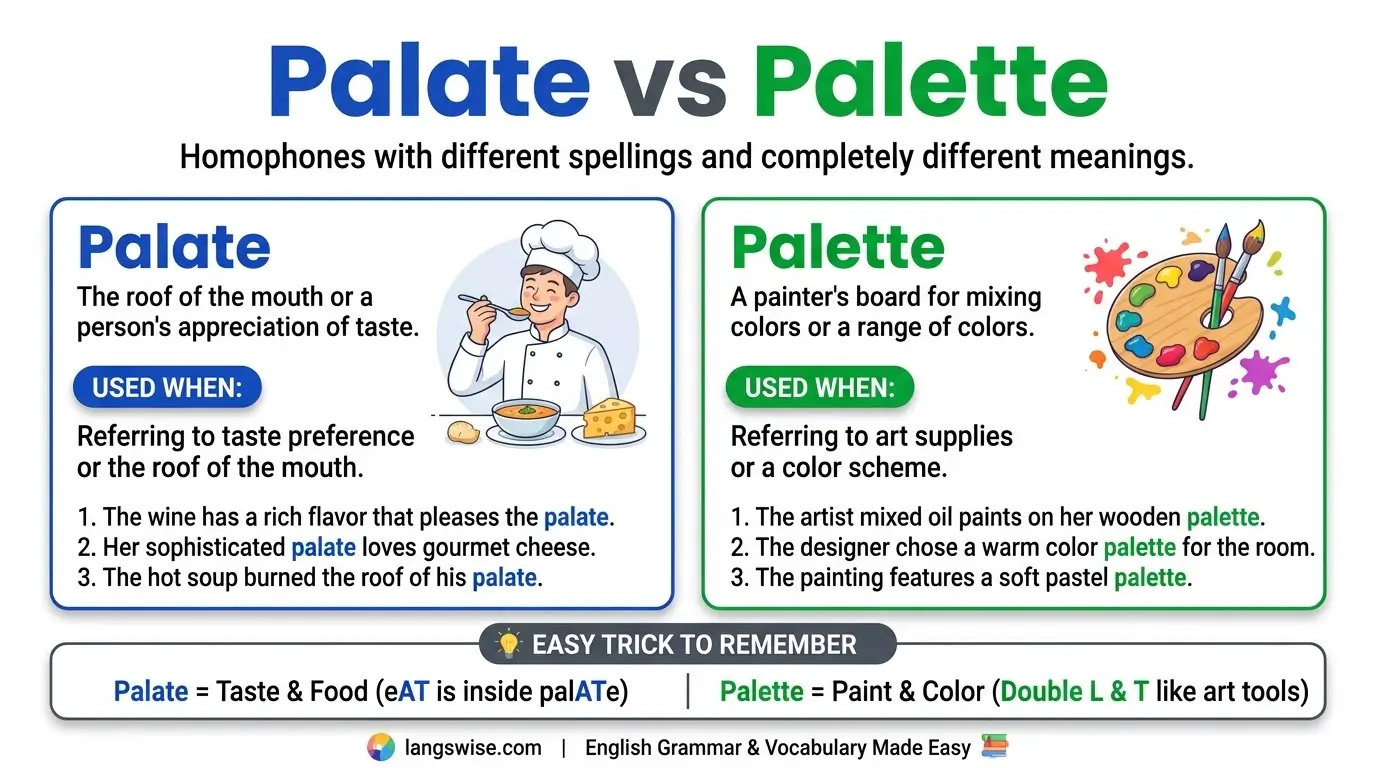
Palate or Palette? Learn When to Use Each Word
Palate refers to taste or the roof of the mouth, while palette means a range of colors used in art and design.
Have you ever wondered whether to write palate or palette? These two words sound exactly alike, but they have very different meanings.
One relates to taste and flavor, while the other refers to colors used in art and design. Choosing the wrong spelling can change the meaning of your sentence.
This confusion often happens because English has many words that share the same pronunciation but have different spellings.
Palate and palette are common examples of homophones. They can be difficult to remember, especially when writing emails, school assignments, articles, or professional documents.
Understanding the difference is simple once you learn what each word means. This guide explains their meanings, origins, spelling differences, and everyday uses.
You will also find practical examples, common mistakes, and answers to frequently asked questions.
Palate or Palette Quick Answer
Both palate and palette are correct English words, but they have different meanings.
Palate refers to the roof of the mouth or a person’s sense of taste, while palette means a board or range of colors used by artists and designers.
Here is the easiest way to remember them:
- Palate: Related to taste, flavor, or the roof of your mouth.
- Palette: Related to colors, painting, and artistic design.
Examples:
- She has a sweet palate and enjoys desserts.
- The artist chose a bright color palette for the painting.
- Spicy food may not suit everyone’s palate.
Remember, use palate when discussing food and taste. Use palette when talking about colors and art.
The Origin of Palate or Palette
The words palate and palette have different historical roots. Although they sound alike today, their spellings developed from separate words with different meanings.
Palate comes from the Latin word palatum, meaning the roof of the mouth.
It entered English through Old French and became associated with taste, flavor, and the structure inside the mouth.
Palette comes from the French word palette, meaning a small board or blade.
Artists used this board to hold and mix paints before applying them to a canvas.
Over time, palette also developed a wider meaning. Today, it can describe a selected range of colors, styles, or visual elements.
Their different origins explain why both spellings exist. They are not alternative spellings of the same word. Each has its own meaning and purpose.
British English vs American English Spelling
There is no spelling difference between British and American English when using palate and palette.
Both words have the same spelling and meaning in the United States, the United Kingdom, Canada, Australia, and other English-speaking regions.
However, their meanings depend on context. Writers must choose the correct word based on whether they are discussing taste or colors.
| Word | American English | British English | Meaning |
|---|---|---|---|
| Palate | Palate | Palate | Taste or roof of the mouth |
| Palette | Palette | Palette | Board or range of colors |
Examples in American English:
- The restaurant offers dishes for every palate.
- The designer selected a warm color palette.
Examples in British English:
- The chef prepared a meal for every palate.
- The artist used a soft colour palette.
Notice that British English often uses colour instead of color. However, the word palette itself does not change its spelling.
Which Spelling Should You Use?
Choosing between palate and palette depends on what you want to describe. Neither spelling is more correct than the other. Both are standard English words used in different situations.
For American English: Use palate when discussing taste or the mouth. Use palette when describing colors, painting, or design.
For British and Commonwealth English: Follow the same rule. Both words keep their standard spellings in British, Australian, Canadian, and other Commonwealth writing.
For global English: Remember the difference between taste and color. This simple rule will help you write clearly for readers around the world.
If you work in food writing, cooking, or restaurant reviews, you will often need palate. If you work in painting, photography, fashion, or graphic design, palette may appear more frequently.
Common Mistakes with Palate or Palette
Many writers confuse palate and palette because both words have the same pronunciation. However, using one in place of the other can create spelling and meaning errors.
Here are some common mistakes and their corrections:
| Incorrect Sentence | Correct Sentence |
|---|---|
| She has a colorful palate. | She has a colorful palette. |
| The artist mixed colors on her palate. | The artist mixed colors on her palette. |
| This dish suits my palette. | This dish suits my palate. |
| He has a refined palette for food. | He has a refined palate for food. |
| The chef created a new color palate. | The chef created a new color palette. |
Mistake 1: Using palette for taste
Incorrect: The spicy dish pleased my palette.
Correct: The spicy dish pleased my palate.
Mistake 2: Using palate for colors
Incorrect: The designer selected a blue palate.
Correct: The designer selected a blue palette.
Mistake 3: Assuming both words are interchangeable
Palate and palette are not interchangeable. Always check the meaning before choosing a spelling.
Palate or Palette in Everyday Examples
Both words appear in everyday communication. Their correct use depends on the subject and the message you want to share.
1. In Emails
Use palate when discussing food, menus, or customer preferences. Use palette when discussing colors, branding, or design projects.
Examples:
- Our new menu offers something for every palate.
- Please review the proposed color palette before the meeting.
2. In News
News articles often use palate in stories about restaurants, food trends, and cooking. Palette appears in articles about art, fashion, photography, and interior design.
Examples:
- The restaurant introduced dishes to suit every palate.
- The designer presented a fresh palette for the new collection.
3. On Social Media
Social media users often use palette when sharing artwork, makeup looks, photography, and color combinations. Palate is more common in food reviews and cooking posts.
Examples:
- I love the soft pastel palette in this painting.
- This dessert is perfect for anyone with a sweet palate.
4. In Formal Writing
Both words are suitable for professional and academic writing. Use palate for discussions about taste, food science, or anatomy.
Use palette when writing about visual arts, branding, design, and color theory.
Palate or Palette – Google Trends & Usage Data
Palate and palette appear in different search contexts because people use them for different purposes. Their search popularity can change depending on location, industry, and user interests.
Palette is commonly associated with art, graphic design, fashion, makeup, and photography. Searches may include phrases such as color palette, makeup palette, and artist palette.
Palate is often connected with cooking, food, taste, and anatomy. Common searches include refined palate, sweet palate, and roof of the mouth.
Search interest may vary across the United States, United Kingdom, Canada, Australia, and other English-speaking countries. However, this does not mean that one spelling is more correct than the other.
Google Trends measures relative search interest rather than exact search volumes. Without a specific live comparison, it would be misleading to claim that one word is more popular in a particular country.
You can compare both terms using Google Trends.
Palate vs Palette: Comparison Table
The following table makes the differences easy to understand.
| Feature | Palate | Palette |
|---|---|---|
| Meaning | Sense of taste or roof of the mouth | Board or range of colors |
| Word type | Noun | Noun |
| Pronunciation | PAL-it | PAL-it |
| Main use | Food, taste, anatomy | Art, design, colors |
| Example | A refined palate | A warm color palette |
| Related words | Taste, flavor, mouth | Color, painting, design |
| Common context | Cooking and food | Art and creativity |
Easy memory tip: Palate has an association with eating and tasting. Palette has an association with paint and colors.
Frequently Asked Questions
1. Is it palate or palette?
Both spellings are correct, but they have different meanings. Palate relates to taste or the roof of the mouth. Palette refers to a board or selection of colors.
2. What does palate mean?
Palate means the roof of the mouth or a person’s sense of taste. It is often used when describing food preferences. For example, she has a refined palate.
3. What does palette mean?
Palette refers to a flat board used by artists to mix paints. It can also describe a selection of colors used in art, fashion, or design.
4. Are palate and palette pronounced the same?
Yes, both words are pronounced the same way. They sound like “PAL-it.” However, their spellings, origins, and meanings are different.
5. Is color palette or color palate correct?
Color palette is the correct expression. It describes a group of colors selected for a painting, website, design, or other creative project. Color palate is incorrect in this context.
6. Is it a refined palate or a refined palette?
A refined palate is the correct expression when describing someone with a developed sense of taste. It often refers to a person who can recognize and appreciate different flavors.
7. Do British and American English spell palate and palette differently?
No, both varieties use the same spellings. The words have identical meanings in British and American English. Only the surrounding vocabulary may differ.
Conclusion
Understanding the difference between palate or palette is easy once you remember their meanings. Although these words sound alike, they are not interchangeable.
Palate refers to the roof of the mouth or a person’s ability to taste and enjoy different flavors. Palette refers to an artist’s board for mixing paints or a selected range of colors.
There is no British or American spelling difference between these two words. Both spellings are correct worldwide, but each belongs in a different context.
Use palate when writing about food, taste, cooking, or anatomy. Choose palette when discussing painting, graphic design, fashion, or color combinations.
The easiest way to avoid mistakes is to connect palate with taste and palette with paint. Remembering this simple difference will help you write more clearly in emails, articles, social media posts, and professional documents.