
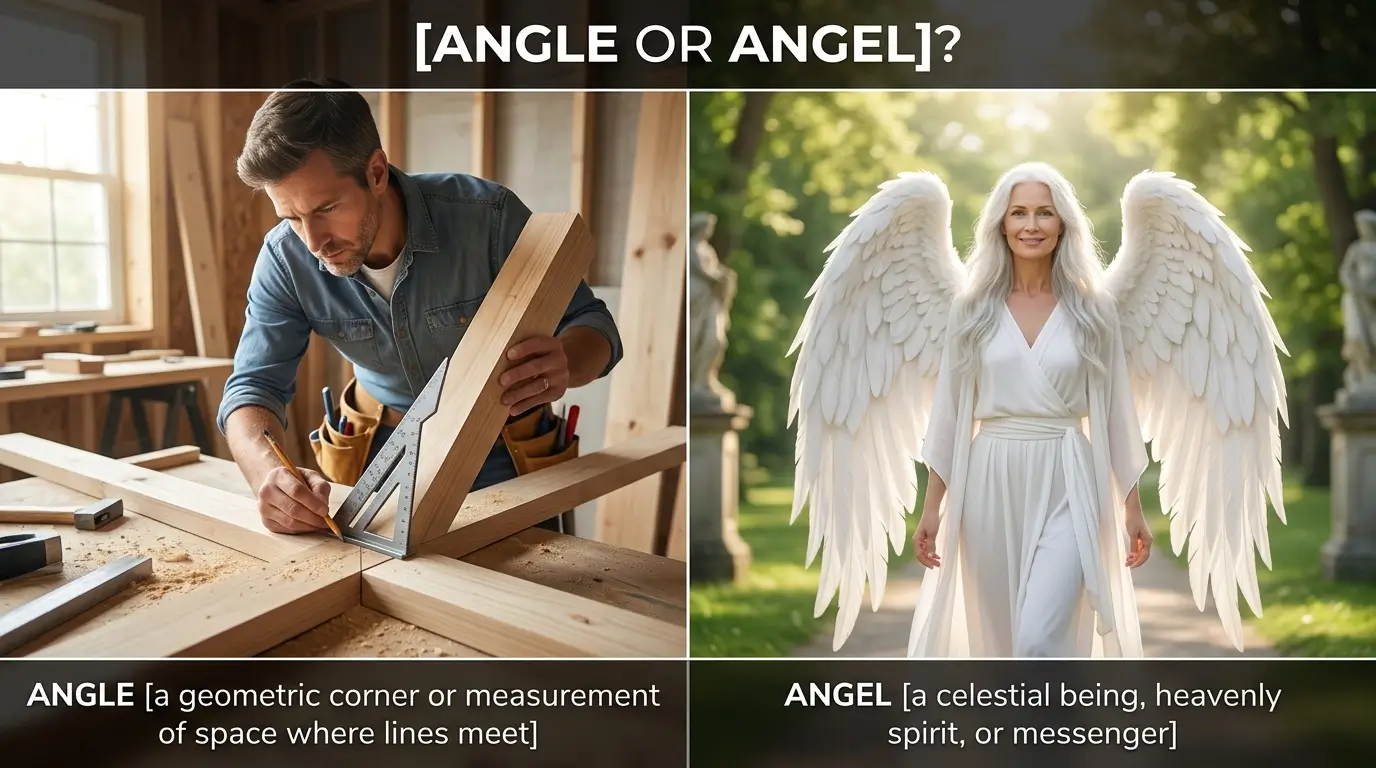
Angle or Angel: Which One Do You Really Mean?
You are typing fast. You need a word that starts with “ang” and means a point of view, or maybe a shape, or maybe a winged being from the sky.
Your fingers slip. Autocorrect jumps in. And now you are staring at a sentence that says “look at this from a different angel” and something feels off but you cannot say why.
This mix-up happens more than you would think. “Angle” and “angel” are spelled almost the same, sound almost the same when said quickly, and both start showing up in your memory at the same time when you are writing under pressure.
But they are not two spellings of one word. They are two totally different words with two totally different meanings.
This confusion shows up in emails, school essays, news headlines, and social posts every single day. People search “angle or angel” because they want a fast, clear answer before they hit send or submit.
This article gives you that answer. Plain and simple. No guessing.
Angle or Angel Quick Answer
Here is the short version.
Angle is a noun and it means:
- The space between two lines or surfaces that meet at a point (a 90-degree angle)
- A point of view or way of looking at something (from a different angle)
- To fish with a rod and line (to angle for trout)
Angel is a noun and it means:
- A spiritual being, often shown with wings, seen as a messenger of God
- A kind, caring, or generous person (“she’s an angel for helping”)
Quick examples:
- “The carpenter measured the angle of the roof.” (shape/math)
- “Let’s look at this problem from a new angle.” (viewpoint)
- “The painting showed an angel with white wings.” (spiritual being)
- “Thank you for the ride, you’re an angel.” (kind person)
If you are talking about math, shapes, corners, or a point of view, you want angle. If you are talking about something spiritual, heavenly, or a really kind person, you want angel.
The Origin of Angle and Angel
These two words look alike by pure accident. They come from completely different roots.
Angle traces back to the Latin word angulus, meaning “corner” or “bend.” It moved into Old French as angle and then into English keeping close to that same shape and meaning. The word has always been about corners, points, and bends, in geometry and in language.
Angel comes from a different path entirely. It goes back to the Greek word angelos, meaning “messenger.”
This became angelus in Latin, then angele in Old French, and finally angel in English. The core idea of “messenger,” specifically a messenger from God, has stayed attached to this word for thousands of years.
So why do people mix them up? Not because of shared history. It is simply because the two words look almost identical on a page: same first four letters, similar length, similar sound.
Our brains take shortcuts when reading and writing fast, and that is where the slip happens.
British English vs American English Spelling
Here is something worth knowing: angle and angel do not change spelling between British and American English.
Both words are spelled the same way on both sides of the Atlantic. This is not a “color vs colour” situation.
The real issue is not regional spelling. It is that people confuse two separate words for each other, no matter where they live.
| Word | British English | American English | Meaning |
|---|---|---|---|
| Angle | angle | angle | shape, corner, viewpoint |
| Angel | angel | angel | spiritual being, kind person |
| Angling (fishing) | angling | angling | act of fishing with rod |
| Angelic (related to angel) | angelic | angelic | like an angel, pure, gentle |
Since spelling stays the same everywhere, the fix is not about region. It is about slowing down for one extra second and checking which meaning you actually want.
Which Spelling Should You Use?
Since there is no British vs American split here, the real question becomes: which word should you use?
If you live in the US, UK, Canada, Australia, or anywhere English is spoken: The rule is identical everywhere. Use angle for shapes, corners, and points of view. Use angel for spiritual beings and very kind people.
For students and formal writing: Always double-check this pair before submitting any paper. Teachers and editors notice this mistake quickly because it changes the entire meaning of a sentence.
For business and professional emails: A wrong word here can look careless to a client or manager. Read your sentence back and ask: am I talking about a shape or a spirit? That answers it every time.
For casual texting and social media: Mistakes here are lower stakes but still confusing to readers. A quick mental check before posting saves you a correction comment later.
Common Mistakes with Angle or Angel
Here are the mix-ups people make most, and how to fix each one.
Mistake 1: “Let’s try a different angel on this problem.” Fix: “Let’s try a different angle on this problem.” (You mean viewpoint, not a spiritual being.)
Mistake 2: “The roof has a steep angel.” Fix: “The roof has a steep angle.” (Shape and slope need “angle.”)
Mistake 3: “She’s my guardian angle.” Fix: “She’s my guardian angel.” (A protective spiritual figure is an “angel.”)
Mistake 4: “He went fishing to angel for bass.” Fix: “He went fishing to angle for bass.” (The verb form of fishing is “angle,” not “angel.”)
Mistake 5: “That singer has an angle voice.” Fix: “That singer has an angelic voice.” (You want the adjective “angelic,” built from “angel.”)
Quick memory trick: Angle has an “L” that looks like a straight line, like the line of a shape. Angel has an “E” before the “L,” and angels are often pictured with wings that curve, like the curve of an “E.” If that trick does not stick, just remember: math and viewpoints use angle. Anything heavenly or kind-hearted uses angel.
Angle or Angel in Everyday Examples
In emails: “I think we should approach this project from a fresh angle before the client call.”
In news headlines: “Local teacher called a ‘guardian angel’ after saving student from fire.”
In social media posts: “Can’t believe how steep this ski slope angle is 😳 #skiing” “Shoutout to my sister, she’s a literal angel for watching my dog all week 🐶💕”
In formal writing (school or business): “The report examines the issue from an economic angle, focusing on long-term growth.” “The charity has been described as an angel investor in the local arts community.”
Notice how “angle” always connects to shape, math, or perspective, while “angel” always connects to something spiritual, protective, or kind. Once you see the pattern, it becomes automatic.
Related Post: Assure or Ensure? The Simple Way to Never Mix Them Up Again
Angle or Angel Google Trends & Usage Data
Search interest in this exact confusion, “angle or angel,” stays steady year-round rather than spiking around any holiday or event.
This tells us it is a genuine everyday spelling and word-choice question, not tied to one season.
By country, search volume for this comparison tends to run highest in the United States, United Kingdom, Canada, Australia, and India, which lines up with the largest populations of English learners and writers worldwide.
Students, content writers, and non-native English speakers make up a large share of the people searching this term, since the words are a classic example of confused word pairs taught in English grammar lessons.
Context also matters here. Searches often pair “angle or angel” with related terms like “angel investor,” “guardian angel meaning,” “right angle,” and “angle brackets,” which shows people are usually mid-sentence, checking one specific word choice before they finish writing something real, whether that is a school paper, a work email, or a social caption.
Comparison Table: Angle vs Angel Variations
| Term | Part of Speech | Meaning | Example |
|---|---|---|---|
| Angle | Noun | Shape formed by two lines/a viewpoint | “a 45-degree angle” |
| Angle | Verb | To fish, or to present something a certain way | “to angle for a promotion” |
| Angel | Noun | Spiritual messenger being | “an angel appeared” |
| Angel | Noun | A very kind or generous person | “you’re an angel” |
| Angelic | Adjective | Resembling an angel; pure, gentle | “an angelic smile” |
| Angling | Noun/Verb (-ing form) | The sport of fishing | “he enjoys angling on weekends” |
| Angel investor | Noun phrase | A person who funds startups | “she found an angel investor” |
| Right angle | Noun phrase | A 90-degree angle | “the table has right angles” |
FAQs
Is it “different angle” or “different angel”?
It is “different angle.” You are talking about a different point of view or way of looking at something, which is the “angle” meaning.
How do I remember the difference between angle and angel?
Think of “angle” as having a straight “L” like a straight line in geometry. Think of “angel” as having wings, and the letters “e-l” at the end can remind you of gentle, flowing wingtips. Math and viewpoints get “angle.” Anything spiritual or kind gets “angel.”
Is “guardian angle” or “guardian angel” correct?
“Guardian angel” is correct. A guardian angel is a protective spiritual being. “Guardian angle” is a common typo with no real meaning.
Does British English spell “angel” differently than American English?
No. Both “angle” and “angel” are spelled exactly the same in British and American English. There is no regional spelling difference for this word pair.
What is an “angel investor”?
An angel investor is a person who provides money to a new or small business, usually in exchange for part ownership. This term always uses “angel,” never “angle.”
Can “angle” be used as a verb?
Yes. “To angle” can mean to fish with a rod and line, or to present information in a certain way, such as “to angle a story toward a specific audience.”
Why do spell checkers sometimes miss this mistake?
Both “angle” and “angel” are real, correctly spelled words, so a basic spell checker will not flag either one as wrong. It only catches misspelled words, not the wrong word used correctly. This is why proofreading by eye still matters.
Conclusion
“Angle” and “angel” trip people up because they look so close on the page, not because of any British versus American spelling rule.
They are simply two different words with two different jobs. “Angle” belongs to math, shapes, and points of view. “Angel” belongs to spiritual beings and truly kind people.
The good news is that once you see the pattern, it sticks. Ask yourself one question before you write either word: am I describing a shape or a viewpoint, or am I describing something heavenly or kind-hearted?
That single question solves the mix-up every time, whether you are writing a text message, a school paper, or a business email.
Keep the memory trick handy: straight “L” for angle, gentle wingtip “el” for angel. Read your sentence back once before hitting send.
That one habit will keep this common mix-up out of your writing for good, no matter where in the world you are writing from.