Tears or Tares: Meaning, Spelling, and Examples
The words tears and tares are both correct English spellings, but they have different meanings.
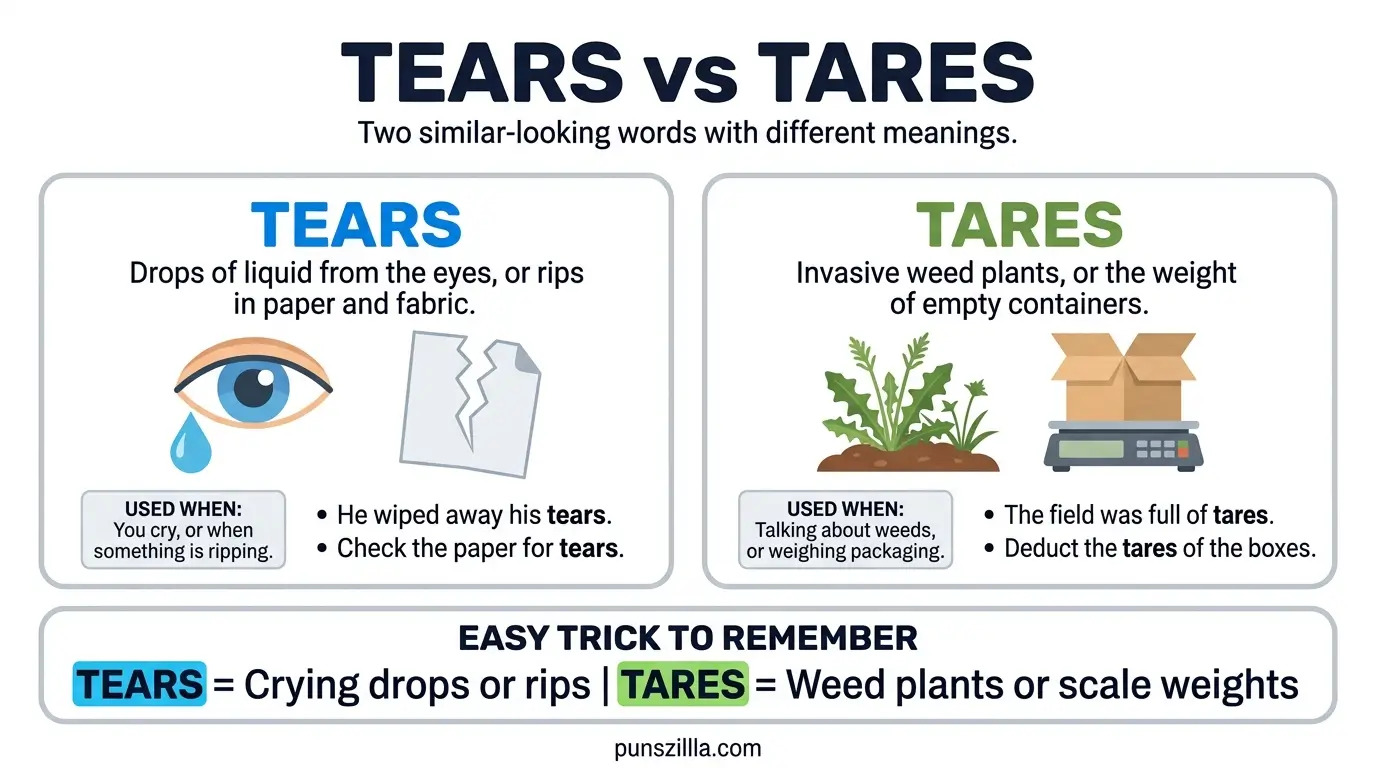
Use tears when talking about drops from your eyes or something being ripped apart, and tares when referring to certain plants or the empty weight of a container.
Writers often confuse these words because they look and sound similar. However, choosing the right spelling depends on the sentence.
For example, you might write, “She wiped away her tears” when describing sadness. In contrast, “The tare weight of the container is five kilograms” is correct when discussing measurements.
Understanding this difference can help you avoid spelling mistakes in school assignments, emails, professional documents, and online posts.
It is also useful for English learners because tears has more than one pronunciation and meaning. The context tells you which meaning is intended.
In this guide, you will learn the definitions, origins, pronunciation, and everyday uses of both words. You will also find examples and answers to common questions so you can choose the right word with confidence.
Tears or Tares Quick Answer
Both words are correct, but they are not interchangeable.
- Tears: Drops of liquid from the eyes, or the plural of a tear in a piece of material. The word can also refer to the present-tense action of pulling something apart.
- Tares: The plural of tare, meaning certain plants that grow among crops or the weight of an empty container or wrapping.
Examples:
- She cried tears of joy when she received the award.
- The warehouse worker checked the tares before calculating the net weight.
For more details, see the Cambridge Dictionary entry for tare.
The Origin of Tears and Tares
The two words have different histories, even though their spellings are similar.
The origin of tears
According to Dictionary.com, tear, meaning a drop of liquid from the eye, comes from Old English tēar and related earlier Germanic forms. The word has been used in English for centuries.
The word tear also means to pull something apart by force. This is a separate historical sense that comes from Old English teran. Its past tense is usually tore, and its past participle is torn.
The two meanings of tear have different pronunciations. The noun for a drop from the eye rhymes with peer, while the verb meaning to rip something rhymes with air in many English accents.
The origin of tares
The word tare has several established meanings. The American Heritage Dictionary lists a type of plant and the weight of a container as noun meanings. Cambridge Dictionary also defines tare as the weight of an empty vehicle or container.
The plant-related word has Middle English roots. The weight-related word entered English through a different historical route, ultimately linked to Arabic. These are distinct word histories, not alternative spellings of tears.
The important point is that tears and tares are separate words with separate meanings, rather than British and American spelling variations.
Spelling Comparison
| Spelling | Where it’s used | Tone | Example |
|---|---|---|---|
| Tears | Everyday, emotional, and descriptive writing | Neutral | Tears rolled down her cheeks. |
| Tears | Describing damage or the verb tear | Neutral | This paper tears easily. |
| Tares | Agriculture and plant descriptions | Technical or specialized | Tares grew among the crops. |
| Tares | Weighing goods and containers | Technical or commercial | The scale recorded the tares. |
There is no simple British-versus-American spelling rule here. Both spellings exist in standard English, but the intended meaning determines which one you need.
Which Spelling Should You Use?
The best spelling depends on what you want to say and who will read your writing.
General and modern writing
Use tears when writing about crying, sadness, happiness, or ripped material.
- Correct: “He was moved to tears.”
- Correct: “There are tears in my shirt.”
Use tares when discussing plants or the weight of packaging and containers.
– Correct: “The tare weight is printed on the label.”
Formal and academic writing
In academic work, use the word that matches the subject. Literature may discuss tears as a symbol of grief, while agriculture may discuss tares as plants growing among crops. Scientific and commercial documents may use tare when describing measurements.
Do not replace one word with the other simply because they look similar.
Business and technical writing
In shipping, manufacturing, and weighing, tare weight is an important term. It refers to the weight of an empty container or vehicle, which is deducted from the combined weight to calculate the weight of the goods.
For example:
“The gross weight is 25 kilograms, and the tare weight is 5 kilograms. Therefore, the net weight is 20 kilograms.”
Cambridge Dictionary confirms this technical use of tare. See its definition of tare.
When following a style guide
If your school, publisher, or workplace has a style guide, follow its instructions for formatting, terminology, and technical measurements. However, no regional spelling preference changes the basic distinction between tears and tares.
Common Mistakes with Tears or Tares
Here are six mistakes to avoid.
1. Using tares for crying
Incorrect: She wiped the tares from her eyes.
Correct: She wiped the tears from her eyes.
2. Using tears for empty container weight
Incorrect: The box has a tare weight of two kilograms, written as “tears” on the report.
Correct: The box has a tare weight of two kilograms.
3. Confusing tears with tore
Incorrect: Yesterday, she tears the paper.
Correct: Yesterday, she tore the paper.
Tore is the usual past-tense form of the verb tear, meaning to rip.
4. Confusing tears with torn
Incorrect: The shirt is tears.
Correct: The shirt is torn.
Use torn when describing something that has been ripped.
5. Assuming the words are regional variants
Incorrect: Tears is American English, while tares is British English.
Correct: Both spellings are used in standard English, with different meanings.
6. Ignoring the meaning of the sentence
Incorrect: The tare rolled down her cheek.
Correct: The tear rolled down her cheek.
A drop from the eye is a tear, not a tare.
Tears or Tares in Everyday Examples
The following examples show how to use each word naturally in different situations.
In an email
- “I was moved to tears by your kind message.”
- “Please confirm the tare weight of each shipping container.”
In a news headline
- “Fans in Tears After Emotional Farewell”
- “New Rules Require Accurate Tare Weight Records”
These are illustrative headlines, not quotations from published news reports.
In a social media post
- “Happy tears today! I finally achieved my goal.”
- “Learning how tare weight affects shipping costs.”
In formal writing
- “The speaker’s emotional account brought several members of the audience to tears.”
- “The tare weight was deducted from the gross weight to calculate the net weight of the shipment.”
These examples show that tears is common in personal and descriptive writing, while tares often appears in specialized contexts.
Usage and Popularity
Tears is widely used in everyday English because it describes crying and can also refer to rips or the action of ripping something. It appears naturally in conversations, stories, news reports, personal messages, and literature.
Tares is less common in general conversation because its meanings are more specialized. The word may appear in agricultural writing, plant descriptions, commercial weighing, and shipping documents.
Dictionary definitions support these differences in meaning, but this comparison is not a measured ranking of search volume or word frequency. No specific Google Trends figures or percentages are claimed here.
For everyday writing, you will usually need tears when discussing emotions or damage. You will need tares when the subject involves plants or container weight.
Tears vs. Tares: Comparison Table
| Word | Part of speech | Meaning | Example sentence |
|---|---|---|---|
| Tears | Plural noun | Drops from the eyes | Tears filled her eyes. |
| Tears | Plural noun | Rips or holes | The fabric has several tears. |
| Tears | Verb | Pulls something apart | This paper tears easily. |
| Tares | Plural noun | Certain plants, including vetches | Tares grew in the field. |
| Tares | Plural noun | Weights of empty containers or packaging | The tares were recorded on the form. |
The Cambridge Dictionary’s entry for tear confirms the different meanings of tear, while its entry for tare explains the measurement-related meaning.
Frequently Asked Questions
1. Which is correct, tears or tares?
Both are correct. Use tears for drops from the eyes or rips in material. Use tares for certain plants or the weight of an empty container.
2. Are tears and tares pronounced the same?
In many English accents, tares and tears (when referring to crying) sound alike. However, tears meaning “rips” or “pulls apart” has a different pronunciation. The context helps you understand which word is meant.
3. What is the past tense of tear?
The past tense of tear, meaning to rip, is tore. Its past participle, used with forms of have or be, is torn.
Examples:
- I tore the paper yesterday.
- I have torn the paper.
4. Is tares a real English word?
Yes. Tares is the plural of tare. It can refer to certain plants or to the weight of containers and packaging, depending on the context.
5. Is tears formal or informal?
Tears is suitable for both formal and informal writing. It appears in everyday conversations, literature, news articles, and academic writing.
6. Is tares used in British or American English?
Tares is a valid English word, not a spelling reserved for one country. Its use depends mainly on the subject being discussed, such as agriculture or weight measurement.
7. What is the plural of tear?
The plural is tears, whether you mean drops from the eyes or rips in material.
Example: “The letter had two tears, and she cried tears of relief.”
8. Can I use tears and tares in the same sentence?
Yes, if the sentence requires both meanings.
Example: “As tears filled her eyes, the farmer checked the tares in the shipment record.”
Conclusion: Remember the Difference Between Tears and Tares
Choosing between tears and tares becomes easy when you focus on meaning rather than spelling. Both words are correct, but they serve different purposes in English.
Use tears when writing about crying, emotional moments, ripped material, or the action of pulling something apart. It is the word you will most often need in everyday conversations, personal messages, stories, and general writing.
Use tares when discussing certain plants or the weight of empty containers and packaging. This word is more likely to appear in agricultural, commercial, or technical contexts.
Remember that tear also has two pronunciations, depending on whether it means a drop from the eye or the act of ripping something. Learning these distinctions will help you understand sentences more clearly and avoid common spelling mistakes.
You do not need to memorize complicated spelling rules to choose correctly. Simply identify what the sentence describes, then select the matching word.
The one-line rule to remember: Use tears for crying or ripping, and tares for plants or container weight.