
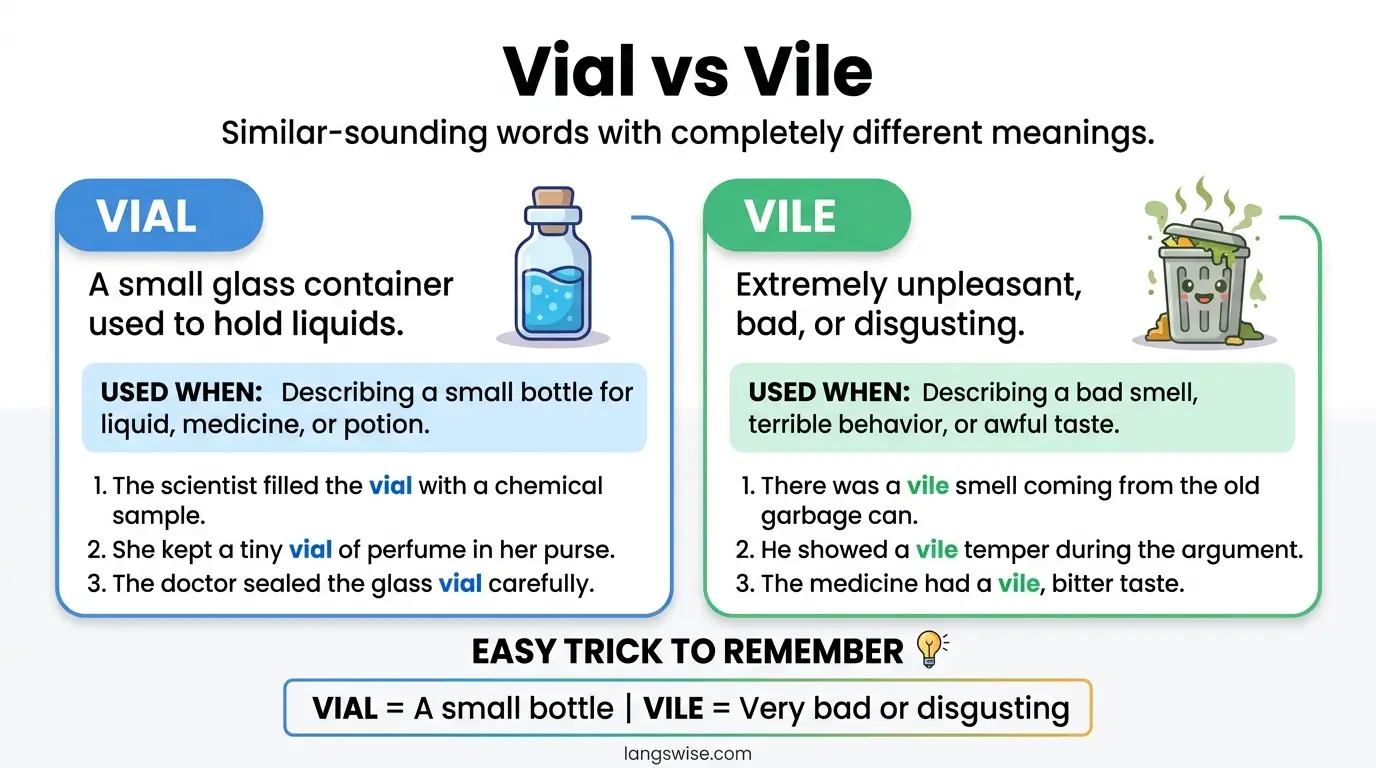
Vial or Vile: Which Is Correct? Meaning, Spelling, and Examples
Have you ever wondered whether to write vial or vile? These two words sound exactly the same, but they have very different meanings.
Choosing the wrong one can change the meaning of your sentence completely.
The confusion happens because both words are pronounced /vaɪl/. However, one refers to a small container, while the other describes something very bad, cruel, or unpleasant.
This makes them common examples of English homophones.
People often search for “vial or vile” when writing emails, school assignments, reports, or everyday messages. They want to know which spelling is correct and how to use each word without making a mistake.
The good news is that the difference is easy to understand.
You only need to remember what each word means and look at the context of your sentence.
In this guide, you will learn their meanings, origins, spelling differences, and practical examples. You will also discover which word to use in American, British, and international English.
Vial or Vile Quick Answer
Both vial and vile are correct English words, but they have different meanings.
- Vial: A small glass or plastic container used to hold medicine, liquid, or other substances.
- Vile: An adjective that means extremely bad, cruel, unpleasant, or morally wrong.
Examples:
- The nurse placed the medicine in a small vial.
- The criminal committed a vile act.
Easy way to remember:
- Vial = A container.
- Vile = Something very bad.
Neither spelling is more correct than the other. The right choice depends on what you want to say.
What Is the Difference Between Vial and Vile?
The main difference is their meaning and grammatical use. Although they sound the same, they are used in different situations.
| Feature | Vial | Vile |
|---|---|---|
| Meaning | A small container | Extremely bad or unpleasant |
| Part of speech | Noun | Adjective |
| Pronunciation | /vaɪl/ | /vaɪl/ |
| Main use | Medicine and liquids | Behavior, actions, and things |
| Example | A vial of medicine | A vile comment |
Vial is a physical object. You can hold it, open it, or fill it with liquid.
Vile describes the nature or quality of something. It often expresses strong disapproval.
The Origin of Vial and Vile
Although vial and vile sound alike today, they developed from different historical word forms.
Origin of Vial
The word vial comes through Old French from medieval Latin phiala, meaning a small bottle or container. Its deeper history is linked to Greek phialē, which referred to a shallow bowl or drinking vessel.
Over time, the word became associated with small containers used to store liquids, medicines, and other substances.
Today, vial is commonly used in medicine, science, laboratories, and healthcare.
Origin of Vile
The word vile comes from Old French vil and Latin vilis, meaning cheap, worthless, or of little value.
Its meaning later developed to describe things considered morally bad, disgusting, or deeply unpleasant.
Today, people use vile to describe cruel actions, offensive language, unpleasant behavior, and terrible conditions.
Why Are Their Spellings Different?
Their spellings are different because they have separate linguistic histories.
English spelling preserves many historical differences even when pronunciation becomes identical. This is why vial and vile sound the same but have different spellings and meanings.
British English vs American English Spelling
There is no spelling difference between British and American English for these two words.
Both varieties use vial for a small container and vile for something extremely unpleasant or bad.
| Word | American English | British English | Meaning |
|---|---|---|---|
| Vial | Vial | Vial | Small container |
| Vile | Vile | Vile | Extremely bad |
| A medicine vial | Correct | Correct | Container for medicine |
| Vile behavior | Correct | Correct | Very bad behavior |
American English Examples
- The doctor prepared a vial of medicine.
- His comments were vile and offensive.
British English Examples
- The laboratory stored the sample in a glass vial.
- The newspaper condemned the vile behavior.
Important: You do not need to change either spelling when writing for American or British readers. The meanings remain the same.
Which Spelling Should You Use?
The correct spelling depends on the meaning of your sentence, not the country where you live.
For American English
Use vial when talking about a small container. Use vile when describing something terrible or unpleasant.
Examples:
- The scientist examined the vial.
- The article described the conditions as vile.
For British English and Commonwealth Countries
Both spellings are also correct in British English and Commonwealth English.
However, British English sometimes uses phial as another spelling for a small container. Vial is also understood.
Examples:
- The pharmacist checked the medicine vial.
- The writer described the behavior as vile.
For Global English
If you write for an international audience, follow these simple rules:
- Use vial for bottles or small containers.
- Use vile for unpleasant or morally bad things.
- Keep the spelling consistent throughout your writing.
- Check the meaning before choosing either word.
Professional advice: Do not treat vial and vile as American and British spelling variations. They are two separate words with different meanings.
Common Mistakes with Vial or Vile
Writers sometimes confuse these words because they sound alike. Here are some common mistakes and their corrections.
| Incorrect sentence | Correct sentence | Explanation |
|---|---|---|
| The doctor opened a vile of medicine. | The doctor opened a vial of medicine. | Vial means a container. |
| He made a vial comment. | He made a vile comment. | Vile describes something unpleasant. |
| The nurse filled the vile. | The nurse filled the vial. | A container is needed here. |
| That was a vial thing to do. | That was a vile thing to do. | Vile describes bad behavior. |
| She carried a vile of perfume. | She carried a vial of perfume. | A small bottle is a vial. |
How to Avoid These Mistakes
Remember these simple tips:
- If you mean a small bottle, write vial.
- If you mean something cruel or disgusting, write vile.
- Read the complete sentence to check its meaning.
- Use a dictionary if you are unsure.
A useful memory trick is to connect the letter A in vial with a container, and E in vile with an unpleasant experience.
Vial or Vile in Everyday Examples
Understanding these words becomes easier when you see them in everyday writing.
1. In Emails
Vial:
“The laboratory sample has been placed in a labeled vial.”
Vile:
“Please avoid using vile language in professional communication.”
2. In News Reports
Vial:
“Researchers collected samples in small glass vials.”
Vile:
“The report condemned the vile treatment of innocent people.”
3. On Social Media
Vial:
“The perfume sample came in a tiny vial.”
Vile:
“That was a vile comment, and it was completely unnecessary.”
4. In Formal Writing
Vial:
“The substance was stored in a sealed vial for further examination.”
Vile:
“The investigation revealed a pattern of vile and dishonest conduct.”
5. In Everyday Conversation
Vial:
“Can you pass me the small vial on the table?”
Vile:
“That was a vile thing to say.”
These examples show that context is the easiest way to choose the correct spelling.
Vial or Vile Google Trends & Usage Data
People search for “vial or vile” because both words have the same pronunciation but different meanings.
This makes the phrase useful for spelling questions, vocabulary lessons, and English grammar searches.
However, Google Trends does not provide exact search counts for these words. Its data shows relative search interest rather than the total number of searches. Google News Initiative+1
Search Interest by Country
For a proper country comparison, Google Trends allows users to compare the terms vial and vile across different locations.
| Country or region | Main usage context |
|---|---|
| United States | Medicine containers, science, and vocabulary |
| United Kingdom | Medicine, laboratories, and general English |
| Canada | Healthcare, education, and everyday writing |
| Australia | Medical and scientific writing |
| India | English learning, education, and healthcare |
| Pakistan | English spelling, vocabulary, and education |
These are examples of language-use contexts, not verified Google Trends rankings.
Which Word Is Used More Often?
The words appear in different contexts:
- Vial is common in medical, pharmaceutical, and scientific writing.
- Vile is common in descriptions of unpleasant behavior, language, and events.
Their search popularity can change depending on the topic, country, and selected time period.
How to Check Google Trends Yourself
- Enter “vial” as the first search term.
- Add “vile” as the comparison term.
- Select Worldwide or a specific country.
- Choose a time range.
- Compare the interest graphs and regional results.
Remember that a higher Trends score means greater relative interest within the selected comparison. It does not represent an exact number of searches. Google News Initiative+1
Vial vs Vile – Quick Comparison Table
Use this table as a quick reference whenever you are unsure which word to choose.
| Comparison | Vial | Vile |
|---|---|---|
| Word type | Noun | Adjective |
| Meaning | Small container | Extremely bad |
| Pronunciation | /vaɪl/ | /vaɪl/ |
| Refers to | Physical object | Quality or behavior |
| Synonyms | Bottle, phial, container | Awful, nasty, wicked |
| Opposite | No direct opposite | Good, decent, pleasant |
| Common context | Medicine, science | Behavior, language |
| Example | A vial of liquid | A vile person |
Remember: Vial names an object, while vile describes something.
Frequently Asked Questions (FAQs)
1. Is it vial or vile?
Both words are correct, but they have different meanings. Vial means a small container, while vile describes something extremely bad or unpleasant.
2. Are vial and vile pronounced the same?
Yes. Both words are pronounced /vaɪl/ in common English pronunciation. They are homophones because they sound alike but have different meanings and spellings.
3. What does vial mean?
A vial is a small container, usually made of glass or plastic. It is often used to hold medicine, perfume, chemicals, or other liquids.
4. What does vile mean?
Vile is an adjective that describes something extremely unpleasant, cruel, disgusting, or morally wrong.
For example: “His vile behavior upset everyone.”
5. Is vial a noun or an adjective?
Vial is mainly a noun. It names a small container used to store liquids or other substances.
6. Is vile a noun or an adjective?
Vile is an adjective. It describes a person, action, comment, or situation that is extremely unpleasant or morally bad.
7. Is vial or vile correct in British English?
Both are correct in British English. Vial means a small container, while vile describes something very bad. British English also uses phial as an alternative spelling for the container.
Conclusion:
Choosing between vial or vile is easy once you understand their meanings. Both words sound the same, but they serve different purposes in English.
Vial is a noun that refers to a small container used for medicine, liquids, perfume, and laboratory samples.
Vile is an adjective that describes something extremely unpleasant, cruel, disgusting, or morally wrong.
Neither spelling is exclusive to American or British English. Both varieties use vial and vile with the same meanings. British English also recognizes phial as an alternative spelling for a small container.
The easiest way to avoid mistakes is to check the context of your sentence.
If you are talking about a bottle or container, choose vial. If you are describing terrible behavior, offensive language, or something unpleasant, choose vile.
Remember this simple rule: Vial is something you can hold, while vile is something you would describe as very bad.
With this distinction in mind, you can use both words correctly in emails, schoolwork, professional documents, and everyday conversations.